

More applications of artificial intelligence beyond text generation, image creation, and even question and answer are being discovered by businesses. The future of artificial intelligence lies in creating technology that is able to comprehend a business environment, analyze data, and act accordingly.
This is where FancyAI agentsturn out to be interesting. Rather than thinking of the AI as a device which requires constant direction at all times, it can be designed to take on particular responsibilities and goals. According to FancyAI, the platform it offers is defined through its AI experts who can operate within the existing business environment.
What really matters is not what the AI agent produces but whether it is able to understand the background of the action and use the information to take the next step.
What Are FancyAI Agents?
FancyAI Agents are AI agents that are built to work with specific skills/functions of business. This means that you don’t have to ask your generic AI model to do everything for you but can apply specialized agents to accomplish your goals.
Right now, FancyAI is presenting AI experts in various domains like IT, design, marketing, operations, and business processes. The platform also includes the description of integration with CRM, ERP, DAM, social, and advertising systems.
This is important since business decisions are usually based not on a single fact.
For instance, when an ecommerce company is trying to figure out how to promote a certain product, the decision would be made on the base of sales performance, customers’ behavior, creative resources, inventories, and results of advertising. The agent connected to the relevant systems can take into account the entire situation rather than the isolated request.
Why Context Matters in AI Decision Making
The other major aspect that sets a regular AI process apart from an intelligent business workflow is context.
For instance, a typical example would be:
“Make a campaign for this product.”
With a rudimentary AI tool, campaign copy can be made using product description.
On the other hand, context-driven AI will be able to analyze other factors such as campaign history, customer information, product details, available brand assets, and business goal.
Thus, the entire process becomes different.
In addition to merely creating content, AI is also operating under certain circumstances.
That is why a context-based AI is beneficial for enterprises where information is scattered across several platforms.
How FancyAI Agents Can Turn Context Into Action
The general process can be understood through four stages: understanding, analyzing, deciding, and executing.
| Stage | What Happens | Example |
|---|---|---|
| Understand | The agent interprets the objective | Identify why sales have dropped |
| Analyze | Relevant business information is examined | Review sales, traffic, products, and campaigns |
| Decide | Possible actions are evaluated | Identify products or campaigns needing attention |
| Execute | The selected workflow is carried out | Create assets or launch the next task |
The advantage of this approach is that the workflow can move beyond an isolated AI response.
FancyAI describes its enterprise platform as connecting AI employees with existing systems and allowing them to handle multi-step execution toward business objectives.
FancyAI Agents for Business Operations
Operation teams spend a lot of time exchanging information across systems.
The launch of a new product may be recorded in the ERP system. The marketing department requires the same product-related information, specifications, pictures, and promotions. Historically, different workers had to gather all that information manually.
Automated workflow using AI technology can automate such processes at least in part.
For instance, one of the applications available in the desktop version of FancyAI is described as an ERP integration, which can initiate the creation of the assets on registering a new product, whereas CRM workflows use customer data for personalized promotions.
This is how AI business automation can help connect information and action.
Using AI Agents for Customer Decisions
Context can also make AI more applicable when dealing with customer experience.
When a company deals with a customer, it is usually not done in a vacuum. The business already has data on past interactions, purchases, preferences, support queries, etc.
By using this relevant data, the AI can better understand what kind of actions and workflow would be most appropriate.
For instance, a company could employ the AI agent to find out which customers seem most likely to disengage from the brand and then create an appropriate workflow for retaining them.
According to the definition of FancyAI, it provides the CRM workflow based on customer behavioral analysis, churn risk assessment, and reengagement marketing campaigns.
The point here is not to automate communication but to make it contextual.
AI Agents in Marketing and Content Workflows
There are also many good examples of marketing departments which benefit from the usage of AI agents.
The contemporary marketing process may consist of the following steps:
customer research
campaign building
content creation
visual creation
performance analysis
social media
advertising
reporting
But when all these steps are carried out separately, then employees may need to waste much time on transferring data from one tool to another.
The platform of FancyAI is aimed at integration of business systems with AI experts, whereas the desktop application is aimed at providing processes of campaign creation, performance creative, trends analysis and advertising platforms.
FancyAI Agents vs Traditional Automation
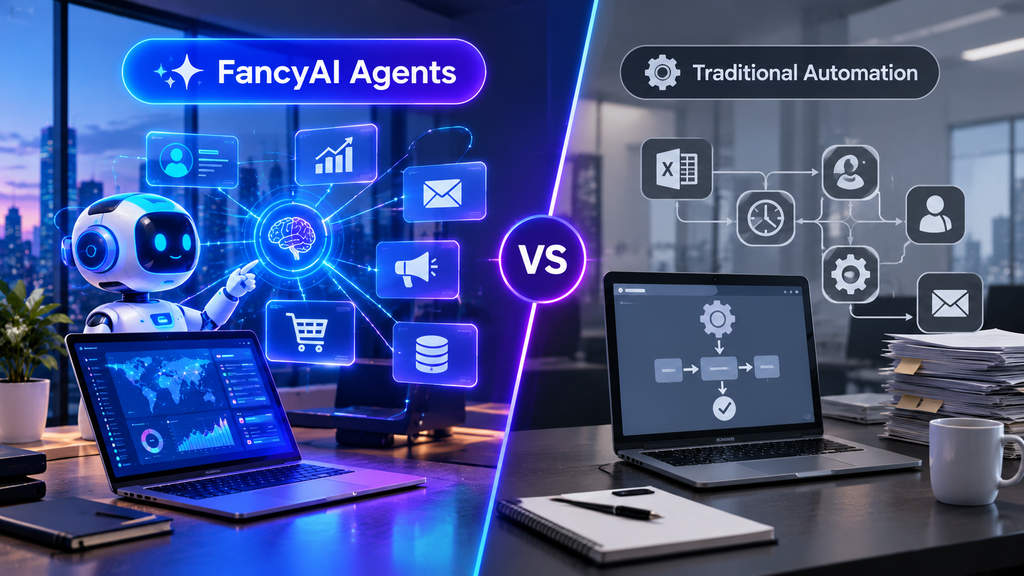
Traditional automation generally follows predefined rules.
For example:
If a customer submits a form → send an email.
This can come in handy, but it is most effective when the process can be predicted.
There is a higher degree of flexibility possible through AI agents because they can make sense of the information available to them and decide on the course of action needed.
| Traditional Automation | AI Agent Approach |
|---|---|
| Rule-based workflows | Goal-oriented workflows |
| Usually follows fixed conditions | Can interpret changing context |
| Requires predefined paths | Can handle more variable situations |
| Best for repetitive processes | Useful for complex multi-step tasks |
| Limited decision-making | Can analyze information before acting |
However, that does not mean AI agents have to be deployed in all situations where automation has been previously used.
There is still scope for the two systems to function concurrently in a lot of companies.
Human Oversight Still Matters
Increased autonomy of AI does not diminish the need for human supervision.
Organizational decisions may have monetary implications, affect client relations, impact company image, involve issues of privacy, and include certain risks. Therefore, companies should specify the kinds of tasks their AI agents are permitted to perform autonomously and those that need to be approved.
One helpful framework is the three-level classification of tasks as follows:
- low-risk tasks – the agent can accomplish them automatically;
- medium-risk tasks – the agent prepares the task, and the human evaluates it;
- high-risk tasks – the agent analyses and proposes a course of action, but a person makes a decision.
In this way, businesses can use the advantages of autonomous AI agents without equating automation with irresponsibility in decision-making.
Challenges Businesses Should Consider
AI-based agents can improve workflow connectivity, but there is still room for proper planning.
Data quality is a factor that needs consideration. Poor data that is outdated or inaccurate may result in poor output.
Integration is another challenge. Companies operate a variety of applications which have different data models and different data access.
Security and permissions are equally important. An agent should have access only to the information that is required to perform a particular task.
FancyAI stresses several enterprise-friendly capabilities like system integration, data isolation, encryption, zero-retention option, and private VPC deployment.
However, companies need to consider their security policies before deploying AI agents.
How Businesses Can Start With AI Agents
It is not necessary that companies have to automate all their operations right from the beginning.
What should ideally be done is that they need to determine the process where employees take a lot of time to collect information, analyze it, and perform subsequent follow-ups.
For instance, an e-commerce company can start with the product launch process.
The process may include:
ERP data → Product analysis → Creative development → Marketing content creation → Approval → Advertising
After this process starts giving desired results, more processes can be linked to it.
The Future of Context-Aware AI Agents
It is expected that the future of AI agents would further evolve toward the understanding of business contexts rather than answering to individual prompts.
As a result of this evolution, businesses do not have to open different services in order to perform research, write, analyze, use customer data, and create things.
It is seen that the direction of development of FancyAI follows this trend, and specialized AI agents become part of enterprise applications that perform complex actions.
These systems are valuable not because they produce more AI content but because they help businesses connect data, decision-making, and implementation.
Final Thoughts
FancyAI agents These examples reflect a much larger trend of how AI can be used by organizations.
The shift here is from the use of AI in general towards creating agents that have an understanding of their surroundings and that can be integrated into a workflow.
In terms of business automation using AI, the question is not what kind of tasks can be automated.
It is about where adding more context, more analysis, and more connections would make a difference.
If AI has an understanding of the context in which a particular task is being done, it becomes more than a generator of content.