
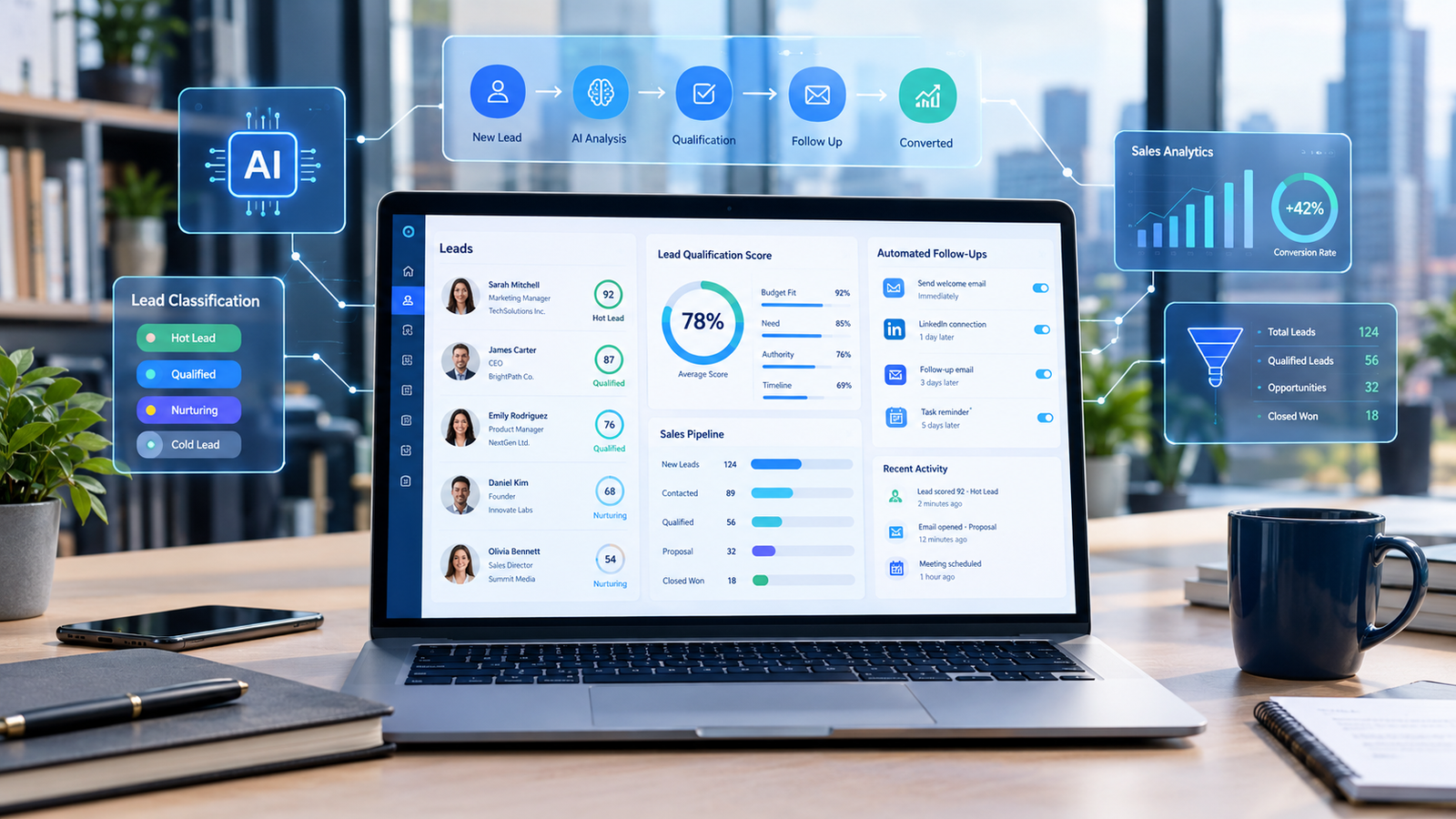
Businesses can get hundreds of leads. Still miss out on sales. Why? Because they don’t always find the people or follow up when it matters. AI lead qualification helps fix this. It uses intelligence to look at lead data check what they really want match it with company goals and send the best leads to the next step.
For businesses this is a big help. Sales teams usually don’t have time. Of having staff go through every form or message by hand an automated system can do the first check. That way people can focus on talks that really need a touch.
This guide explains what AI lead qualification is, how it works, how it’s different, from scoring, where it can help what to watch out for and how to set up a real working system by 2026.
What Is AI Lead Qualification?
AI lead qualification is the use of intelligence to check if a potential customer is a good match for a business. It also checks if that person is likely to need the product or service being offered.
The system looks at things, like:
- Company size
- Industry
- Location
- Job role
- Product interest
- Budget
- Buying timeline
- Customer questions
- Website activity
- Business needs
In words it answers one big sales question:
Which leads should our team focus on first?
Here’s how a simple process might work:
New inquiry → Collect information → AI analysis → Qualification → CRM update → Sales notification → Human follow-up
The AI doesn’t make the final sale. A smart setup gives the AI rules, limited power and a clear point when a salesperson steps in.
Why AI Lead Qualification Matters
Not every lead is worth the same. One person might be ready to make a purchase while another might just be looking around for choices.
If a sales team handles every message in the way important chances can slip away.
Artificial intelligence can handle this step more quickly. It can look at information find patterns sort out leads and send them to different processes.
For example a software company might say a high-priority lead is a business that:
- Fits its target industry
- Has the right company size
- Shows a clear product need
- Has a realistic budget
- Wants a solution soon
- Provides enough information for sales
A lower-priority lead can go into a different process that helps build relationships instead of getting immediate sales contact.
The goal is not to say no to people. The goal is to help sales teams.
How AI Lead Qualification Works
A practical system usually has several connected stages.
1. Capture Lead Information
The process begins when a prospect comes in through a website form, a landing page, an email, a chatbot, an advertisement or a social media channel.
Useful information can include the prospect’s company name, the industry they’re in where they are located what products they are interested, in their budget, their timeline and any questions they have.
Good input matters because an AI system cannot make decisions if the information is missing or not correct.
2. Understand the Lead
Next the AI looks at the information that’s available. That information may be in fields or in natural-language messages.
For example a prospect might write:
“We are a 25‑person marketing agency and need an SEO platform for client websites. We want to choose a solution this month.”
The AI can spot the company size, the industry, the need, the urgency and the buying timeline, from that message.
This is useful when every prospect does not provide information in exactly the same format.
3. Apply Qualification Criteria
The business needs to decide what a good customer looks like.
A company that sells to businesses might look at:
- Industry fit
- Geographic market
- Company size
- Budget
- Decision-maker status
- Product need
- Buying timeline
- Level of engagement
The AI can check each potential customer against these points and put them into a group, like qualified maybe qualified needs attention or needs more checking.
4. Score or Classify the Lead
Qualification and scoring are connected,. They are not the same thing.
Lead scoring usually gives a prospect a number based on traits or actions they take. It’s like a scorecard. Qualification is bigger, than that. It’s about deciding if the prospect really fits the business and what step to take next. It’s not a number. It’s a judgment call.
| Signal | Possible interpretation |
|---|---|
| Target industry | Strong fit |
| Decision-maker role | Strong fit |
| Clear product need | Strong intent |
| Realistic budget | Positive signal |
| Long buying timeline | Lower immediate priority |
| Outside target market | Poor fit |
The exact criteria should always come from the company’s real sales process.
5. Update the CRM
After classification, the workflow can update the CRM automatically.
It might:
- Add qualification status
- Add a score
- Record the reason for classification
- Assign a sales representative
- Create a follow-up task
- Add the prospect to a nurture sequence
- Notify the sales team
This reduces repetitive data entry and gives sales representatives more context before contacting a prospect.
6. Route the Lead
The next step is deciding what happens to each category.
A high-priority prospect could go directly to a salesperson. Someone who needs information could receive an automated follow-up. A prospect, outside the target market could be marked for review.
This is where AI workflow automation becomes particularly useful because qualification is connected to a real business action.
For more information about connected AI workflows, see AI Workflow Automation: How to Automate Business Workflows.
7. Add Human Review
The system must know when to stop.
Important sales decisions, rare customer situations, sensitive information, pricing exceptions or other important actions may need approval.
Businesses should not give an AI system access simply because the AI system can perform more actions. Permissions and review points make the AI system workflow easier to control.
For a broader explanation of how intelligent workflows collect information, analyze it, take action, and improve over time, see How AI Automation Works: 7 Steps Behind Intelligent Workflow.
AI Lead Qualification vs. Traditional Lead Qualification
Traditional qualification usually means sales reps go through leads one by one by hand.
Here’s how it typically goes:
Lead comes in → Salesperson reads the info → Looks at the criteria → Updates the CRM → Figures out what to do
This works fine when you’re getting only a few leads.. As the number of leads grows things slow down and can get messy. Different people might make calls and details can slip through the cracks.
With AI helping the flow changes:
Lead comes in → AI reads the details → Checks the criteria → Sorts the lead into a category → Updates the CRM → Sends a alert to the salesperson → Human reviews
The big shift? AI does the boring repeatable steps. That lets the salesperson spend time where it matters—talking to people handling questions building trust and making calls.
You can also mix AI with automation. Things, like sending a thank-you email after a lead fills out a form can still run on rules.. For anything that needs understanding—like reading a message or judging if a lead is serious—AI can step in and handle that.
AI Lead Qualification vs. Lead Scoring
These terms are often mixed up.
Lead scoring asks:
How strong is this prospect based on the signals we chose?
Lead qualification asks:
Does this prospect match our business and what needs to happen?
A prospect might have a score because they looked at many pages opened emails or got some content. That does not mean they are ready to buy.
Another prospect might come once. Send a detailed message saying they need a solution this week.
A strong sales workflow takes into account the context.
7 Practical Use Cases
1. Website Form Qualification
When a person fills out a contact form on a website artificial intelligence can read what they write figure out what they need and send them to the person.
2. B2B Sales Qualification
Teams that work with businesses can check prospects against company size the industry they’re in the job role, where they are located if the product fits their needs and when they might be ready to buy.
3. Chat-Based Qualification
An artificial intelligence chatbot can ask questions that are already set up understand what the person says and gather details before a salesperson joins the chat.
4. Automated Follow-Up
If a person wants details before talking to a salesperson automation can start a series of messages that are right for the situation.
5. Lead Routing
Artificial intelligence can sort people who might want to buy by product, where they’re from what industry they are in or which sales team should handle them and send them to the right person.
6. Lead Nurturing
People who’re not ready to make a purchase can go into a nurturing process instead of being ignored.
7. Re-Engaging Old Leads
Artificial intelligence can look at records, in the customer relationship management system find clues that might be useful and recommend which people might be worth reaching out to again.
These use cases also connect closely with AI agents because agents can work through multiple steps across business tools. For a practical guide, see How to Use AI Agents to Automate Repetitive Business Tasks.
Benefits of AI Lead Qualification
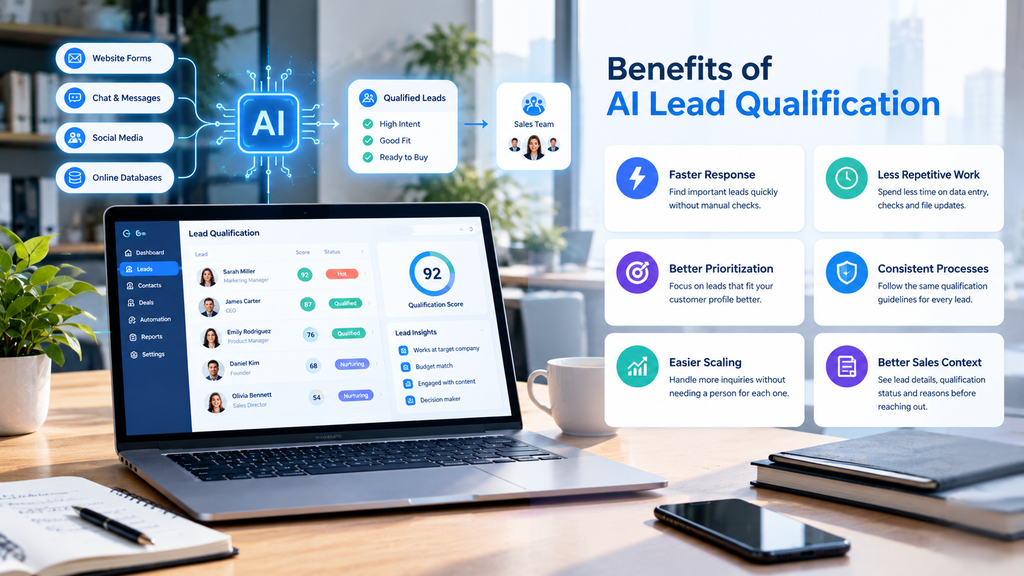
A designed system can bring many advantages.
Faster Response
Artificial intelligence can quickly handle information allowing companies to find important leads without waiting for someone to check it manually.
Faster Response
Artificial intelligence can quickly handle information allowing companies to find important leads without waiting for someone to check it manually.
Less Repetitive Work
Sales representatives spend time entering data checking simple details and updating files.
Repetitive Work
Sales representatives spend less time entering data checking simple details and updating files.
Better Prioritization
Groups can concentrate on leads that fit their customer profile better.
Better Prioritization
Groups can concentrate on leads that fit their customer profile better.
Consistent Processes
Defined qualification guidelines can make the first part of the sales process more the same for all leads.
Consistent Processes
Defined qualification guidelines can make the first part of the sales process more the same, for all leads.
Easier Scaling
As the number of leads increases an automated system can handle inquiries without needing every single one to be looked at by a person.
Easier Scaling
As the number of leads increases an automated system can handle inquiries without needing every single one to be looked at by a person.
Better Sales Context
A salesperson can get the leads details whether it is qualified and why it was classified that way before reaching out.
For small businesses, this approach can be particularly useful. See AI Automation for Small Businesses in the USA: 7 Use Cases 2026 for more practical examples.
Common Mistakes to Avoid
AI lead qualification can create problems when the workflow is poorly designed.
Using Bad Data
If the CRM holds wrong data AI may give bad suggestions.
Using Many Rules
A complex system can be hard to keep up. Start with rules that truly shape sales choices.
Treating AI Decisions as Final
AI can err. Key decisions need a human check step.
Ignoring False Positives
A weak prospect might be tagged as ready. Sales teams must watch these cases. Tweak the rules.
Ignoring False Negatives
A strong prospect could be labeled priority. Frequent reviews can spot missed chances.
Giving AI Much Access
The system should only reach the data and tools it needs. Permissions must fit its role.
Measuring Lead Volume
More handled leads do not automatically equal better results. Businesses must track sales outcomes well.
How to Build an Effective Workflow
Begin with the sales process, not the AI tool. I think the sales process is the core.
First define the customer. Identify the industries, the size of the company the location, the needs, the budgets and other characteristics that matter for the sales process.
Second document the process. Write down how the team decides whether a prospect is worth pursuing in the sales process.
Third identify steps. These steps are usually the places to start automation in the sales process.
Fourth connect the systems. This may involve website forms, CRM software, email, calendars, chat systems and other business applications that feed the sales process.
Fifth create AI instructions. Tell the system which information to consider, which actions it can perform and when it must ask for approval in the sales process.
Sixth, test the workflow. Use both weak prospects to look for wrong classifications missing information and routing problems, in the sales process.
Finally,. Improve the workflow. The workflow should become better as the business learns which signals truly predict sales opportunities.
This approach also connects with broader AI decision-making strategies. See AI Decision Making: Smarter Business Decisions With AI.
Metrics to Track
Do not judge the workflow only by the number of prospects it processes.
Track metrics such as:
- Qualified lead rate
- Sales acceptance rate
- Lead-to-opportunity conversion
- Opportunity-to-customer conversion
- Response time
- Time saved by sales staff
- False-positive rate
- False-negative rate
- Revenue from qualified prospects
- Cost per qualified lead
Comparing these numbers before and after automation can show whether the workflow is actually improving the sales process.
Is AI Lead Qualification Safe?
It can be done. Businesses need to plan the workflow
Lead information might have company details. Companies should think about who can access it how its handled how its kept, how its protected and who is watching over it.
For general advice the NIST AI Risk Management Framework is a helpful outside tool. NIST says the framework is a guide for groups that create, build, put into use or look at AI systems. It focuses on dealing with AI dangers and helping with AI.
The main idea is to do work but put the right controls in place, around private information and big choices..
Final Thoughts
AI lead qualification can help companies take a stream of customer inquiries and turn them into a more organized way to handle sales.
The biggest advantage is not about replacing work that people do manually. It is about helping sales teams use their time in places where human thinking, talking and building relationshipsre most important.
A good system begins with rules for deciding which leads to focus on good data to work with, smart automation, limited access to certain parts and people checking the work. It should also be judged by results, for the company not just numbers that look good but don’t really matter.
Start with one source of leads and one way to handle them. Try it out look at the results make the rules better and then grow from there.
When AI, customer relationship management automation and the skills of sales people all work together companies can react quicker focus on the best chances and stop losing good prospects because no one had time to look at them.
FAQs About AI Lead Qualification
What is AI lead qualification?
AI lead qualification uses artificial intelligence to evaluate prospects based on information such as business fit, needs, behavior, budget, and buying intent. It can then classify or route prospects for the next sales step.
How does AI qualify a lead?
AI can collect information, understand the prospect’s message, compare the information with business criteria, classify the prospect, update the CRM, and route the prospect to the appropriate workflow.
Is AI lead qualification better than manual qualification?
AI can make the first stage faster and more consistent, especially when a business receives many inquiries. Human salespeople should still handle important decisions and conversations.
What is the difference between lead scoring and qualification?
Lead scoring usually assigns a numerical value to a prospect based on selected signals. Qualification is the broader process of deciding whether the prospect fits the business and what should happen next.
Can small businesses use AI for lead qualification?
Yes. Small businesses can start with a simple workflow connected to their website form and CRM. They can expand the system after measuring its results.
Can AI qualify leads from a chatbot?
Yes. An AI chatbot can ask qualifying questions, understand answers, collect information, and send the prospect to a CRM or sales workflow.
Does AI lead qualification replace salespeople?
No. The strongest approach uses AI for repetitive analysis and routing while salespeople handle relationship building, complex questions, negotiation, and important decisions.