

The emergence of artificial intelligence is transforming the way in which companies collect data, know their clients, recognize opportunities, and make decisions on a regular basis. In addition to analyzing the data manually and using old reports, companies can use AI technology to handle large amounts of data and derive useful information in a short period of time.
Considering the emergence of such technologies, AI decision-making becomes an integral part of the contemporary business strategy. Artificial intelligence can help teams to recognize patterns, consider possibilities, predict outcomes, and help to make decisions related to marketing, sales, finance, customer service, and operations.
AI decision-making is not just about asking the AI tool a question and following the recommendations of the program. The quality of the data, business situation, limitations, and the involvement of people are all important elements affecting the effectiveness of recommendations made by the AI.
What Is AI Decision Making?
AI decision making is the term that describes the use of artificial intelligence to process information and assist in making decisions.
In traditional companies, many business decisions require the participation of employees in collecting information, analyzing reports, comparing various options, and making the final decision. AI technology can help with a number of these steps by providing quick analysis and noticing patterns which might not be easily identifiable otherwise.
For instance, an ecommerce business can apply AI in the analysis of its product sales, consumer behavior, the current level of inventories, as well as previous marketing results. As a result, AI can detect which products may require more marketing efforts, or changes in consumer preferences.
Nevertheless, the ultimate decision can still be made by humans.
How Does AI Decision Making Work?
A decision support system based on AI typically involves multiple interconnected stages.
Gather Appropriate Information
The system should have some information relevant to the decision-making. It could be customer data, sales results, statistics from the company website, inventory management details, financial reports, customer support conversations, marketing statistics, etc.
Analyze the Data
AI-based systems are able to analyze huge sets of data and find connections, patterns, trends, or anomalies within them.
For instance, the system may recognize the decrease in sales of a certain product despite the same number of visits to the company website.
Understand the Context of the Business
Not all of the information may be enough to make an appropriate decision. Therefore, the AI should know business-related information and rules as well.
That is why AI business context plays such a great role in making proper decisions. More about the topic could be learned in the already published article AI Business Context Refinement: Smarter AI Decisions that discusses how to use business-related information, rules, and knowledge to get better AI results.
Human Review or Automation
This stage is influenced by the nature of the workflow.
In situations where there is low risk, automation can be used to perform the next step. In cases where there is high risk, human evaluation is required before taking any steps.
Why AI Decision Making Matters for Businesses
There is an incredible amount of data produced daily by businesses. The problem is not so much in the collection of data but in its comprehension.
The use of artificial intelligence may be helpful in decreasing the time needed for data processing and recognizing insights.
Here are some of the possible uses:
Determining changes in customer behavior
Examining marketing effectiveness
Sales forecasting
Recognizing anomalous business operations
Optimizing customer service procedures
Comparing business performance
Inventory planning
Lead prioritization
Identifying bottlenecks
Financial analysis
However, the goal of AI isn’t necessarily to get rid of the human element from decision-making processes. Rather, AI can help employees access better information, allowing them to spend more time analyzing decisions rather than sorting through data.
However, the goal of AI isn’t necessarily to get rid of the human element from decision-making processes. Rather, AI can help employees access better information, allowing them to spend more time analyzing decisions rather than sorting through data. Those companies looking to automate some of their operations with AI can find out more about the ways these systems are used in the USA in our guide to Droven io AI Automation in USA.
AI Decision Making vs Traditional Decision Making
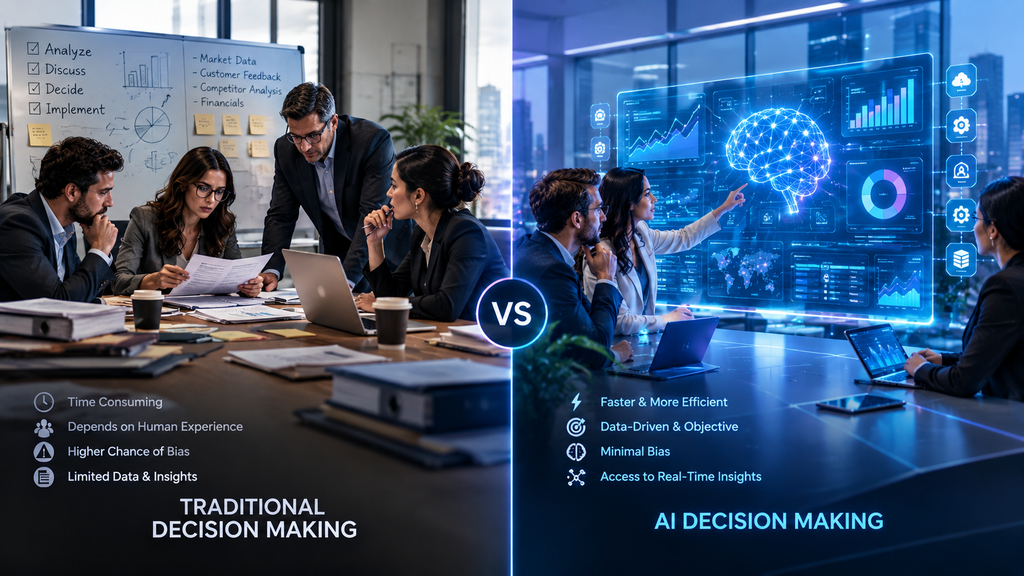
Traditional decision making normally depends on human research and procedures. Workers gather data, go through the data, discuss different options, and make their decisions based on that discussion.
Artificial intelligence could provide an additional layer of analysis here.
| Traditional Decision Making | AI Decision Making |
|---|---|
| Relies heavily on manual analysis | Can process large amounts of information quickly |
| Reports may be reviewed periodically | Information can be analyzed more frequently |
| Employees identify many patterns manually | AI can identify patterns and correlations |
| Decisions may take longer | Recommendations can be generated quickly |
| Often depends on individual experience | Can combine data from multiple sources |
| Human judgment is central | AI can support human judgment |
This does not mean that AI will be always more precise. Low-quality data, wrong assumptions, and lack of context can lead to bad advice. The idea is to use analytical skills of AI together with human judgment.
AI Decision Making in Marketing
Marketing teams may use AI for making decisions regarding campaigns, content, customer segmentation, and advertising.
For instance, an AI tool can evaluate campaigns and compare indicators such as clicks, conversions, customer engagement and costs of acquisitions.
Rather than looking through numerous dashboards, marketing teams can use AI technology to see anomalies and focus on those areas which require attention.
AI can assist in customer segmentation, analyzing behavior and grouping those people who have something in common.
For instance, in case of ecommerce business, the company may find out that those customers who buy some certain product react better to a particular promotion.
AI can assist marketing teams in understanding this pattern and determine what campaigns need further testing.
Businesses interested in implementation of AI recommendations in automated processes can look into AI Automation Services: How Businesses Can Automate Work and Save Time.
AI Decision Making in Sales
Sales teams manage vast amounts of customer data, which include leads, conversations, past purchasing behavior, product interest, and interactions with the company.
AI can make sense of all the above-mentioned data and assist the sales team in prioritizing their leads.
For instance, an AI software can pinpoint the leads who have suddenly become more engaged with the company website and emails. The sales team would then review those leads and choose ones that need their urgent attention.
AI can also help in summarizing the conversation with the customers and highlighting crucial points prior to the sales discussion.
Thus, the AI would eliminate the time spent by employees searching through the CRM database.
AI Decision Making in Customer Service
Customer service is yet another field where AI decision-making assistance may be used.
AI software can study support requests, pinpoint problem areas, categorize discussions, and suggest proper actions.
Thus, when a client contacts a company about a delayed order, AI can analyze the request, order details, shipping status, and corporate policy to come up with the suggestion about what action to take next.
A human specialist would check the suggestions and reply to the client.
Simple requests could be completely automated, while more complicated cases would be handed to humans.
This system can assist companies in keeping their processes automated while not removing the human factor from the equation.
AI Decision Making in Finance
Financial decisions call for meticulous analysis since a mistake can lead to serious repercussions.
AI can help finance departments through analysis of financial documents, detecting suspicious activity, comparing past performance, and producing summaries.
As an illustration, a financial AI could detect any unexpected expense anomaly and bring it into notice.
AI can also help in forecasting through analysis of past data and detection of trends.
Yet, proper controls must be put in place in financial AI systems. Financial decisions must not be blindly based on the recommendations of AI systems.
AI Decision Making in Business Operations
Operations can utilize artificial intelligence in identifying inefficiencies and improving processes.
For example, take the case of a business organization operating its inventory in several locations. The AI could analyze sales trends, inventory levels, seasonal needs, and supply to spot items requiring attention.
In the same way, an AI can analyze workflow information and pinpoint delays.
When a particular step within a business process is taking more time than necessary, AI will point out the problem and provide supporting data for the operations department.
It transforms business information into useful decision-making tool.
The Role of AI Agents in Decision Making
The AI agents are taking AI decision-making support one step forward.
A conventional AI tool will give a response to the user’s question. AI agents have the capability to monitor the data, understand the objective, apply the connected AI tools, and perform various actions according to the workflow.
For instance, a business may use the AI agent to monitor the customer’s activities, find out possible opportunities, make a suggestion, and initiate another workflow.
This makes the AI agents very useful for businesses which want to integrate their decision-making process with automation.
But the businesses need to set up certain permissions and limitations for the agents because the more power an AI system holds, the greater the need to monitor, secure, and oversee it.
Benefits of AI-Powered Decision Making

When implemented carefully, AI decision making can provide several practical benefits.
Faster Analysis
AI can process large amounts of information much faster than manual analysis in many situations.
Better Access to Insights
AI can bring information from different sources together and identify patterns that may otherwise be overlooked.
Reduced Repetitive Work
Employees can spend less time collecting and organizing information before making routine decisions.
More Consistent Processes
Businesses can establish consistent rules for how certain information is analyzed and when recommendations should be escalated.
Improved Responsiveness
AI systems can continuously analyze information, allowing businesses to respond to changes more quickly.
Better Use of Business Data
Organizations often have valuable data stored across different systems. AI can help turn that information into useful insights when the data is properly connected and structured.
Challenges of AI Decision Making
AI decision-making has its own drawbacks too.
The problem with data can become a major limitation since poor quality data input will lead to poor quality recommendation output. The problem with data lies in the fact that the information can become outdated or inaccurate.
Also, the issue can arise with context. The system can be proficient at understanding general business knowledge, but it will not necessarily understand the company’s specific policies, objectives, customer base, or processes.
Issues with privacy and security become crucial since the business will have to maintain control over what type of data is accessible to the AI system and how it is processed.
Finally, there is always a danger of over-automation when all decisions must be automated regardless of their importance and significance.
How to Implement AI Decision Making Responsibly
Businesses do not need to automate every decision immediately.
The best way is to begin with identifying a concrete problem.
Begin with identifying a decision that involves analysis. Next, figure out the kind of data needed and whether this information is credible.
Third, figure out how you will incorporate AI in the process.
Is it going to only offer analysis? Is it going to recommend an action plan? Can it implement the action by itself?
If the decision is one which is delicate, then the approval of a person is something that must not be skipped at any cost.
In business organizations, it is necessary to keep track of the performance of the AI over time. Due to changing circumstances, the information that was previously available may no longer be valid.
The Future of AI Decision Making
AI decision making may increasingly become related to automation, business intelligence, and AI agents.
Rather than using AI as a chatbot or content creation software, businesses will be able to incorporate AI into processes where information is constantly being analyzed and actions initiated on the basis of pre-defined parameters.
The key difference here lies not in AI answering questions but in AI being incorporated into business processes.
As these systems get more powerful, it will no longer suffice for companies to consider what AI can do but also how it can be managed.
Good quality data, sound business logic, proper permissions, human oversight, and constant testing will still be essential elements of any AI implementation.
Final Thoughts
AI decision making can help businesses analyze information, identify patterns, and support faster and more informed decisions.
Its value does not come simply from using an AI model. The surrounding data, business context, workflows, rules, and human oversight all influence how useful the system becomes.
For businesses exploring AI, the best starting point is a clear problem rather than the technology itself. Identify where employees spend time analyzing information, determine whether AI can genuinely help, and introduce automation gradually.
When AI is connected to reliable business information and used within clear boundaries, it can become a practical decision-support layer across marketing, sales, customer service, finance, and operations.
FAQs About AI Decision Making
What is AI decision making?
AI decision making is the application of artificial intelligence technology for analysis of information, recognition of patterns, insight creation, and making business decisions.
How can AI assist in business decision making?
AI can analyze huge volumes of information, find trends and patterns, compare information, and create recommendations to help workers choose between alternative options.
Can AI make decisions independently of human beings?
While some easy and low-risk decisions can be automated, significant business decisions need a certain amount of human analysis and monitoring.
What is AI-driven decision making?
AI-driven decision making implies application of AI technology to analyze business information and take actions according to certain business rules.
What are the benefits of AI decision making?
Benefits may include rapid analysis, decreased repetition, increased access to understanding, more efficient procedures, and enhanced utilization of business information.
Is AI decision making always accurate?
Not necessarily. AI recommendations might be flawed due to erroneous data, lack of context, wrong assumptions, and limitations within the system itself. Businesses need to validate recommendations prior to their implementation.
One thought on “AI Decision Making: Smarter Business Decisions With AI”