
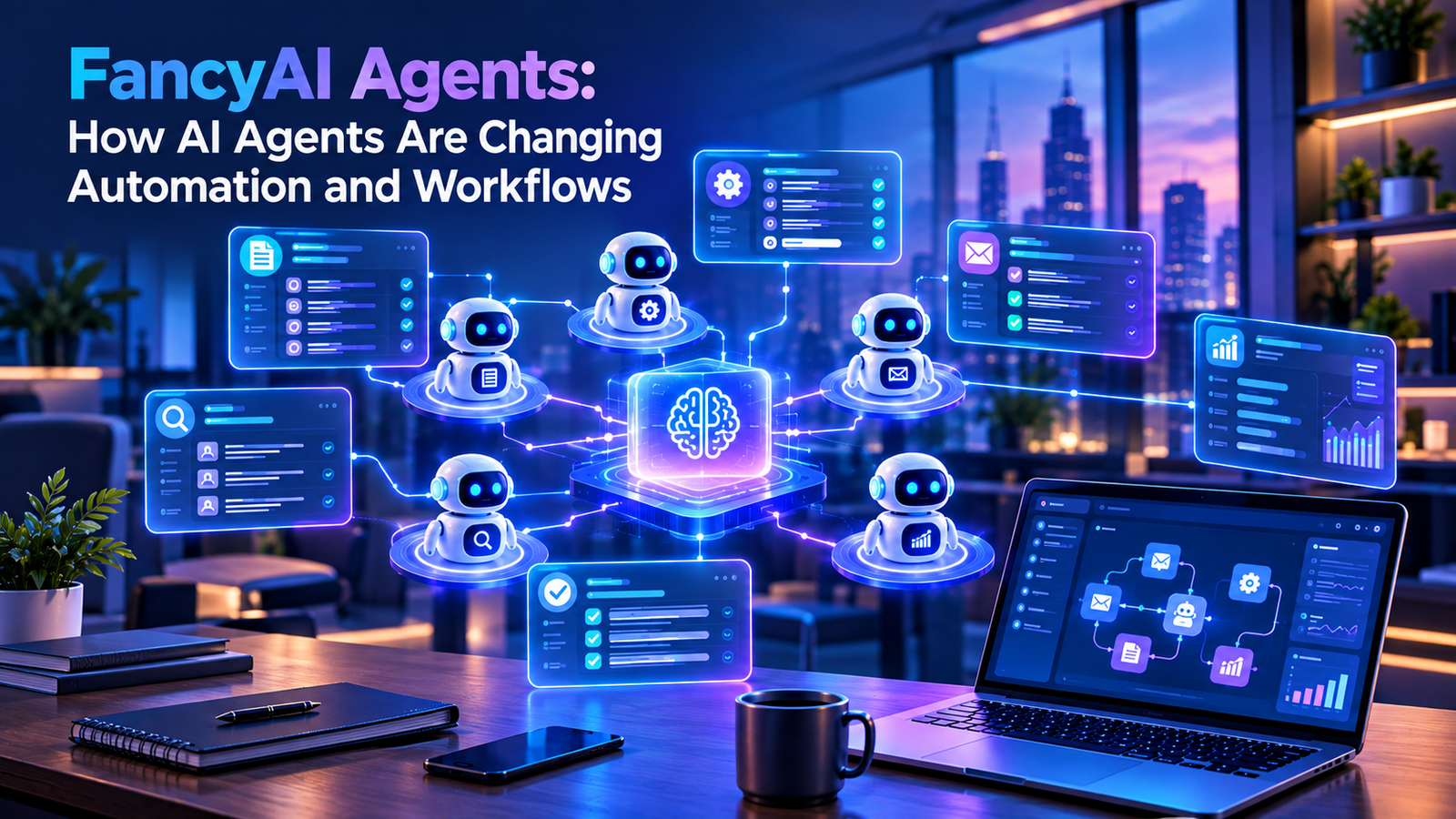
Artificial intelligence is moving beyond simple chatbots and basic software tools. Today, businesses are looking for systems that can understand goals, make decisions, and complete tasks with less manual input. This is where FancyAI agents and other AI agents are becoming increasingly relevant.
Instead of helping with only one task, an AI agent can work through multiple steps to reach a specific outcome. It can analyze information, decide what needs to happen next, and interact with different tools as part of a workflow.
For businesses exploring AI automation, understanding how these systems work can help them identify where AI agents may fit into their daily operations.
What Are FancyAI Agents?
FancyAI agents can be understood as AI-powered systems designed to perform tasks based on a defined objective rather than simply responding to individual prompts.
Traditional AI tools generally wait for a user to provide an instruction. An AI agent can take a broader goal and work through a sequence of actions to complete it.
For example, a basic AI tool might help write a customer email after receiving a prompt. An AI agent could potentially review customer information, determine the appropriate response, prepare the email, and move the task through the next step of a workflow.
The exact capabilities of an AI agent depend on the platform, integrations, permissions, and tasks it has been designed to handle.
How Do AI Agents Work?
AI agents combine artificial intelligence with instructions, context, tools, and workflows. A typical process can involve several stages.
First, the agent receives a goal or task. It then analyzes the available information and determines what actions may be required.
Depending on its setup, the agent can use connected applications or tools to complete those actions. After each step, it can evaluate the result and continue with the workflow.
This makes AI agents different from simple automation that follows a fixed sequence of rules.
For example, an AI agent used for business research could receive a request to collect information about a topic, organize the findings, identify important points, and prepare a structured summary.
Key Features of AI Agents
Modern AI agents can be designed around different business requirements. Some common capabilities include:
Task Automation
AI agents can handle repetitive digital tasks that would otherwise require employees to move information between applications or perform the same actions repeatedly.
Decision-Making
Unlike basic rule-based automation, AI agents can use available information to determine what action may be appropriate within their assigned boundaries.
Multi-Step Workflows
An agent can potentially complete several connected steps instead of requiring a separate instruction for every action.
Context Awareness
AI systems can use relevant information from the current task to produce more useful responses or actions.
Tool Integration
AI agents can work with connected software and business systems when the necessary integrations and permissions are available.
AI Tools vs AI Agents: What’s the Difference?
AI tools and AI agents are related, but they are not exactly the same.
| AI Tools | AI Agents |
|---|---|
| Usually focus on a specific task | Can work through multiple steps |
| Often require direct user instructions | Can work toward a defined goal |
| User may control each action | Can determine the next action within set limits |
| Useful for individual tasks | Useful for broader workflows |
| Often have limited autonomy | Can provide greater task autonomy |
An AI writing tool, for instance, can generate content when someone provides a prompt. An AI agent could potentially manage a larger content workflow by researching a topic, organizing information, creating a draft, and moving it to another stage when properly configured.
This does not mean AI agents automatically replace every AI tool. In many cases, businesses can use both.
How Businesses Can Use AI Agents
Businesses across different industries can explore AI automation through agents for a variety of workflows.
Customer Support
AI agents can help organize customer requests, identify common questions, and route conversations according to predefined business processes.
Marketing
Marketing teams can use AI-powered agents for tasks such as research, campaign support, content workflows, and data organization.
Research
An AI agent can be configured to collect information from approved sources, organize findings, and prepare them for human review.
Sales
Sales teams can explore agents for lead research, information organization, follow-up workflows, and other repetitive administrative tasks.
Data Processing
Businesses often work with large amounts of repetitive information. AI agents can help process, classify, summarize, or organize data when the workflow is properly configured.
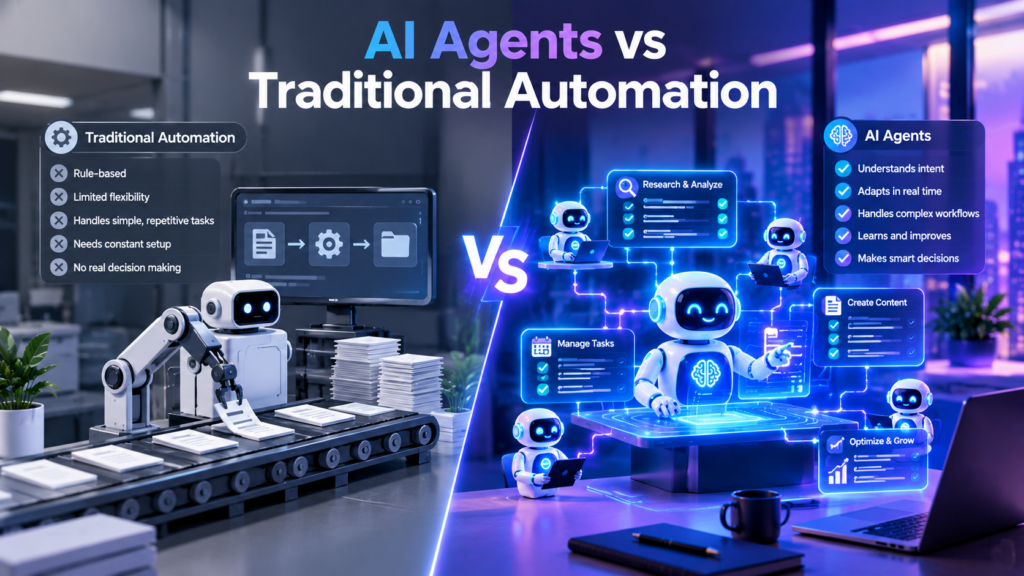
AI Agents vs Traditional Automation
Traditional automation generally works through predefined rules. If a certain condition occurs, the system performs a specific action.
For example:
If a customer submits a form → send an email.
This type of automation remains useful because it is predictable and relatively straightforward.
AI agents introduce another layer. Instead of following only a fixed sequence, an agent can use AI to interpret information and determine what action should come next within its instructions.
For example:
Customer request → understand the request → gather relevant information → decide the appropriate workflow → complete the next action.
However, FancyAI agents should still operate within appropriate permissions and business rules. Human oversight can remain important, particularly for sensitive decisions or high-impact processes.
Benefits of AI Agents for Businesses
One of the biggest reasons businesses are exploring AI agents for workflow automation is the potential to reduce repetitive manual work.
Agents can help teams spend less time on routine digital tasks and more time on activities that require human judgment and creativity.
Other potential benefits include:
- Faster handling of repetitive workflows
- Better organization of business information
- Support for multi-step processes
- Reduced manual data entry
- More consistent workflow execution
- Greater flexibility compared with simple rule-based automation
The actual results depend on the quality of the workflow, data, integrations, and human oversight.
Are AI Agents the Future of Automation?
AI agents are becoming an important part of the broader AI automation conversation. Their ability to work with information, tools, and multi-step processes makes them different from traditional software automation.
Still, businesses should not adopt an AI agent simply because it is new. The right approach is to identify a repetitive or time-consuming process first and then determine whether an FancyAI agentscan solve it effectively.
For straightforward tasks, traditional automation may still be the simpler option. For workflows involving changing information, multiple steps, or AI-based interpretation, an agent-based approach may be worth exploring.
Frequently Asked Questions
What are FancyAI agents?
FancyAI agents are AI-powered agents designed around specific goals and workflows. Their actual functions depend on the platform, integrations, and configuration being used.
How do FancyAI agents work?
FancyAI agents receive a goal, process available information, use connected tools when permitted, and perform a series of actions to complete the assigned workflow.
What is the difference between AI tools and AI agents?
AI tools commonly focus on specific tasks and require direct instructions, while AI agents can work through multiple steps toward a defined objective.
Can FancyAI agents automate business workflows?
Yes. FancyAI agents can be used for various business workflows, including research, customer support, marketing, sales operations, and data processing, depending on their configuration.
Are AI agents the same as traditional automation?
No. Traditional automation generally follows predefined rules, while FancyAI agents can use AI-based reasoning and contextual information to determine actions within their assigned boundaries.
Final Thoughts
FancyAI agents represent the wider shift from basic AI tools toward more goal-oriented systems. Instead of simply responding to individual requests, AI agents can be designed to work through connected tasks and workflows.
For businesses, the biggest opportunity may not be replacing every existing tool, but finding specific processes where AI agents can reduce repetitive work and make workflows easier to manage.
As AI automation continues to develop, understanding the difference between AI tools, traditional automation, and AI agents will help businesses make more informed decisions about where these technologies fit into their operations.
One thought on “FancyAI Agents: How AI Agents Are Changing Automation and Workflows”