

Artificial intelligence is no longer the preserve of big companies with big technical resources. Artificial intelligence can also help small firms streamline their operations, serve clients more efficiently, and save time on repetitive tasks. The problem is knowing where to begin.
That’s where AI consulting for small business can make a real difference. Organizations may employ professional counsel to pinpoint where artificial intelligence may genuinely provide value, rather than jumping on every new AI technology that emerges.
What Is AI Consulting for Small Businesses?
AI Consulting for Small Businesses is the act of helping a corporation understand how artificial intelligence can be applied to the processes and goals they already have. An AI consultant will evaluate how a firm functions, discover where there can be improvements and offer the correct technology or methods.
If you’re a small firm it may be automating customer questions, organizing leads, analyzing business data, creating content or linking different software systems.
The point isn’t just to slap a little AI on a corporation. It’s about applying AI where it actually addresses a real problem.
Why Small Businesses Are Turning to AI
Small companies often work with limited staff and resources. Owners may handle sales, customer service, marketing, administration, and other responsibilities at the same time.
AI Consulting for Small Businesses can help reduce some of this workload.
For example, an AI-powered system can help organize customer messages, summarize information, draft routine emails, or identify patterns in business data. These tasks may seem small individually, but automating them can give business owners and employees more time for work that requires human judgment.
AI Consulting for Small Businesses can also help smaller companies compete in markets where larger businesses already use advanced technology.
What Can an AI Consultant Help With?
The role of an AI consultant can vary depending on the business. Some companies may need help selecting AI software, while others may need assistance designing automated workflows.
Common areas include:
Customer Support
AI-powered chatbots and support systems can handle common questions and provide quick responses. More complex issues can still be transferred to a human team member.
Marketing and Content
AI can assist with brainstorming, content planning, customer research, email drafts, and other marketing tasks. Human review remains important, particularly when content represents a company’s brand.
Lead Management
AI can help organize incoming leads, categorize prospects, and identify follow-up opportunities. This can make sales processes easier to manage when a business receives inquiries from several channels.
Data Analysis
Small businesses often collect useful information but do not have enough time to analyze it. AI tools can help summarize reports, identify trends, and turn large amounts of information into easier-to-understand insights.
Repetitive Administrative Work
Tasks such as copying information between systems, sorting documents, creating routine reports, and sending reminders can often be automated.
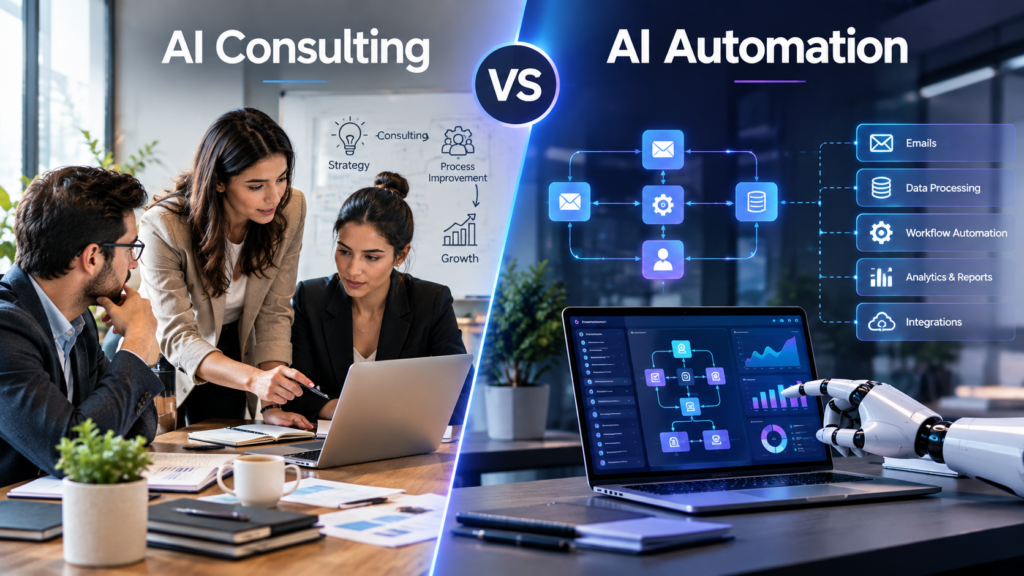
AI Consulting vs. AI Automation
AI consulting and AI automation are not the same, yet they are connected.
“AI consulting is about strategy and identifying the right opportunities. A consultant can look at company processes and indicate where AI should be introduced.
AI automation is more about implementation. It’s about establishing workflows that enable software and artificial intelligence systems to automatically carry out certain activities.
Before implementing AI-powered workflows, it helps to understand the fundamentals of automation and how it can affect business processes. Our guide on what automation is, including its key benefits and drawbacks explains the broader concept and provides useful context for businesses considering automation.
For example, a consultant may learn that a company spends several hours each week answering consumer inquiries. Then an automation solution may connect the company’s forms, CRM, email system and AI capabilities to make that process flow better.
The two approaches can be complementary. Consulting can help identify what needs to be changed, while automation can help identify how it can be improved.
| Feature | AI Consulting | AI Automation |
|---|---|---|
| Main Purpose | Identify where AI can add value | Automate specific business processes |
| Focus | Strategy, planning, and recommendations | Workflow implementation |
| Typical Tasks | Process analysis, tool selection, AI strategy | Data transfer, lead follow-ups, customer responses |
| Human Involvement | High during planning and decision-making | Lower for repetitive automated tasks |
| Best For | Businesses unsure where to start with AI | Businesses ready to automate a specific process |
| Example | Finding which customer-service tasks could benefit from AI | Connecting a chatbot, CRM, and email system |
How AI Can Help Different Types of Small Businesses
AI isn’t tied to a single industry.
An online retailer can employ AI to aid with product descriptions and consumer questions. A marketing organization might employ AI to arrange research and make reporting more efficient. For example, a professional service firm might employ AI to break down documents or field incoming inquiries.
Simple AI applications can even benefit local businesses. Examples of operations that may be ideal for automation are appointment reminders, commonly asked questions, client feedback analysis, and lead follow-ups.
The proper strategy is well … it is contingent upon the company’s workflow, customers, budget and objectives.
How to Choose an AI Consultant
Choosing an AI consultant should involve more than looking at how many AI tools they know.
Start by considering whether the consultant understands business processes as well as technology. A useful consultant should be able to explain how a proposed solution connects to a specific business problem.
It is also worth asking about:
- Previous AI implementation experience
- The tools and platforms they recommend
- Data privacy and security practices
- Integration with existing software
- Expected costs
- Ongoing support
- How success will be measured
A good AI strategy should be practical rather than unnecessarily complicated.
How Much Does AI Consulting Cost?
There is no one price point for AI consultancy. Costs vary widely based on the scale of the project, the experience of the consultant, the technology, and whether implementation is included.
A small organization may choose to begin by conducting a brief consultation or process evaluation before moving into a larger project.
It may be beneficial to start small. Instead of trying to automate an entire organization in one go, companies can pick one repetitive or time-consuming operation and test an AI-based solution.
Other workflows can be considered later, if the results are valuable.
Start With a Specific Business Problem
One of the biggest mistakes companies make is starting with technology rather solving a problem.
Instead of asking, “How can we use AI?” a better question is, “What part of our business takes too much time or creates unnecessary manual work?”.
The solution might point to a big opportunity for AI.
For example, if your personnel are spending hours answering the same customer questions, consider an AI-assisted support approach. If sales professionals have a hard time keeping track of leads, AI might help them organize leads and follow up.
A problem-first approach can make AI adoption more targeted and easier to quantify.
The Future of AI for Small Businesses
Artificial intelligence (AI) technology is moving fast, but small business owners don’t need to jump on all new development. The best way to do this is to think of practical applications that complement corporate goals already in place.
It is expected that as AI technologies grow easier to integrate with conventional business software, smaller organizations would have more options to automate ordinary tasks without constructing sophisticated systems from scratch.
The biggest winners will probably be those organizations that combine technology with clear processes, supervision by humans, and a good grasp of their customers.
Final Thoughts
AI consultancy for small business can offer a disciplined strategy to study artificial intelligence without wasting time or money on ill fitting tools. Artificial intelligence can enhance daily operations in a range of areas, from customer assistance and marketing to data analysis and process automation.
The trick is to first tackle a real business concern, find the right technology to meet the process and then measure whether the solution provides meaningful benefits.
There is no need for AI to change a whole organization overnight. And for many small firms, one good change can be a practical starting step to smarter and more efficient operations.