
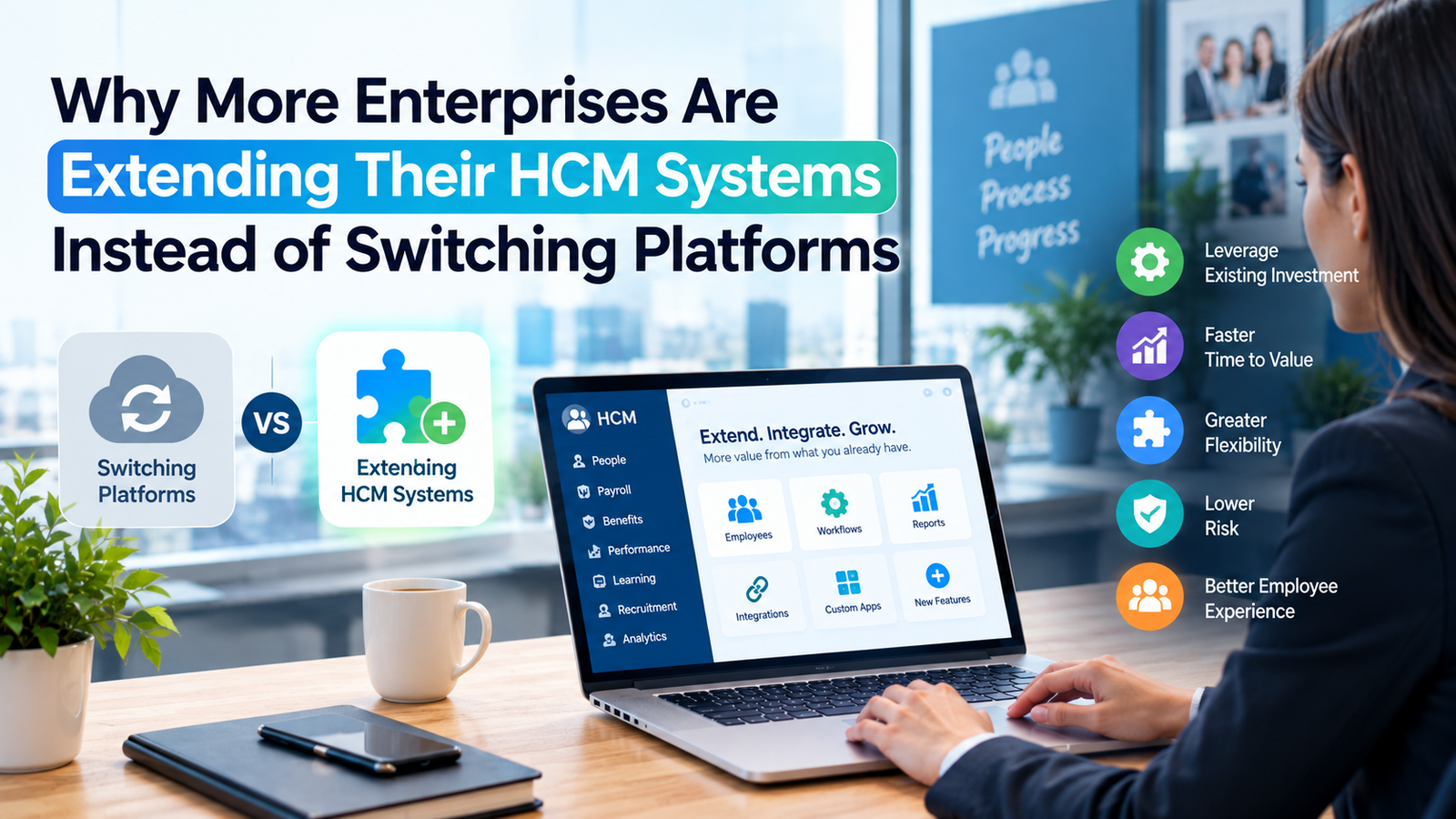
Replacing a core HR system is one of the most disruptive projects an enterprise can take on. Most implementations run for six to twelve months, budgets routinely exceed six figures, and payroll, compliance, and workforce operations must keep running without a hiccup the entire time. So why do so many organizations still treat a workflow gap as a sign it’s time to shop for a new platform? Extending enterprise HCM systems is often the faster, lower-risk path to the same result.
In most cases, a full replacement isn’t necessary. Organizations chose Workday, UKG, or SAP for real reasons: strong payroll and compliance capabilities, established integrations, and years of institutional knowledge built into the configuration. These are mature, well-built platforms. The workflow needs that surface later, whether it’s a multi-state compliance rule, a union pay progression scenario, or mobile access for a deskless workforce, are a natural part of running a large, complex workforce, not a sign that anything is wrong with the system. No single platform, however capable, is designed to anticipate every workflow every organization will ever need. That’s the nature of enterprise software, not a shortcoming of any particular vendor.
The Cost of Treating Every Workflow Need as a Migration Decision
Replacing the system of record to address a workflow need is a mismatch of scale. Migrations are disruptive: data has to move, integrations have to be rebuilt, and employees have to relearn a new interface, all while the business keeps operating. Switching platforms also doesn’t guarantee the underlying need goes away. Organizations often find that similar workflow requirements recur in the new system within a year or two, simply because they’re tied to the nature of the business rather than to which vendor is in place.
There’s a trade-off here, too. Enterprises sometimes consider switching platforms in part to gain more flexibility, but a new implementation entails its own multi-year configuration and integration commitment. Trading one long-term platform relationship for another doesn’t necessarily buy more flexibility. It mostly resets the clock.
What “Extend, Don’t Replace” Looks Like
A different pattern has been gaining traction: rather than replacing the system of record, organizations add a layer on top of it that handles specialized workflows alongside the core platform. This layer typically connects through the HCM’s existing APIs, so it reads and writes data without altering the underlying system. It’s built to take on the specific requirements that fall outside a standard configuration.
Some common scenarios where companies find they need custom workflows alongside their core HCM include:
- Frontline or deskless employees, such as retail associates or field technicians, who need mobile-first tools rather than a full desktop HCM interface
- Union environments with pay progression rules that are highly specific to a single contract or region
- Multi-state or multi-country operations where compliance requirements shift faster than a standard configuration cycle
- Seasonal or high-turnover hiring, where recruitment and onboarding volume call for faster, more automated screening and scheduling
- K-12 and public sector staffing scenarios, such as assigning substitute teachers on short notice
- Manufacturers or distributors that need real-time data flowing between HCM and ERP systems for accurate labor costing
- Reimbursement or variable-pay scenarios, like mileage tracking or tip distribution, that don’t map cleanly to standard payroll categories
Building this kind of layer is a different approach from customizing within HCM itself, which often leads to longer change-request cycles and makes any future migration more complex. An external layer keeps the core system’s configuration clean while still giving the business the flexibility it needs.
Why This Is Happening Now
A few things have changed, making this pattern more workable than it was even a few years ago. AI-assisted and low-code development tools have shortened the time it takes to stand up one of these layers from months to weeks, sometimes days, and that changes the cost-benefit math. IT teams are stretched across more priorities than ever, and business units want changes on their own timelines rather than waiting in an IT backlog. Enterprises are also getting more disciplined about governance, favoring a centrally managed, auditable extension layer over the shadow IT and one-off scripts that tend to pile up when teams are left to solve workflow needs on their own.
This is where a platform like CloudApper’s AI Platform fits in. Its HCM Personalization capability is built to work alongside systems such as UKG, Workday, Dayforce, Oracle Cloud HCM, Sage, and Infor, and has been applied to scenarios including mobile time capture for retail associates, automated union pay progression, and HR service delivery tools. It’s one of several approaches enterprises are exploring as extending enterprise HCM systems becomes a standard part of how large organizations operate, rather than something reserved for unusual cases.
What To Evaluate Before Adopting This Approach
Extending an HCM rather than replacing it isn’t a decision to make lightly, regardless of which vendor or tool is involved. A few questions are worth working through up front: What’s the data governance and security posture of the extension layer, and does it hold relevant compliance certifications? How much of the integration work is pre-built versus custom development? How does the total cost compare to submitting a change request through the HCM vendor? And does the layer stay portable if the organization changes HCM platforms down the road, so the investment carries forward rather than getting locked into one system?
The Bigger Shift
All of these point to a real change in how enterprises think about their software stack. The system of record holds the data. More of the day-to-day workflow logic now lives in a layer built specifically for it. Extending enterprise HCM systems is becoming a standing capability that organizations build into their operations, planned for alongside the core platform rather than bolted on after something goes wrong. For enterprises weighing whether a workflow needs means it’s time to shop for a new platform, that’s usually the more useful question to start with.