
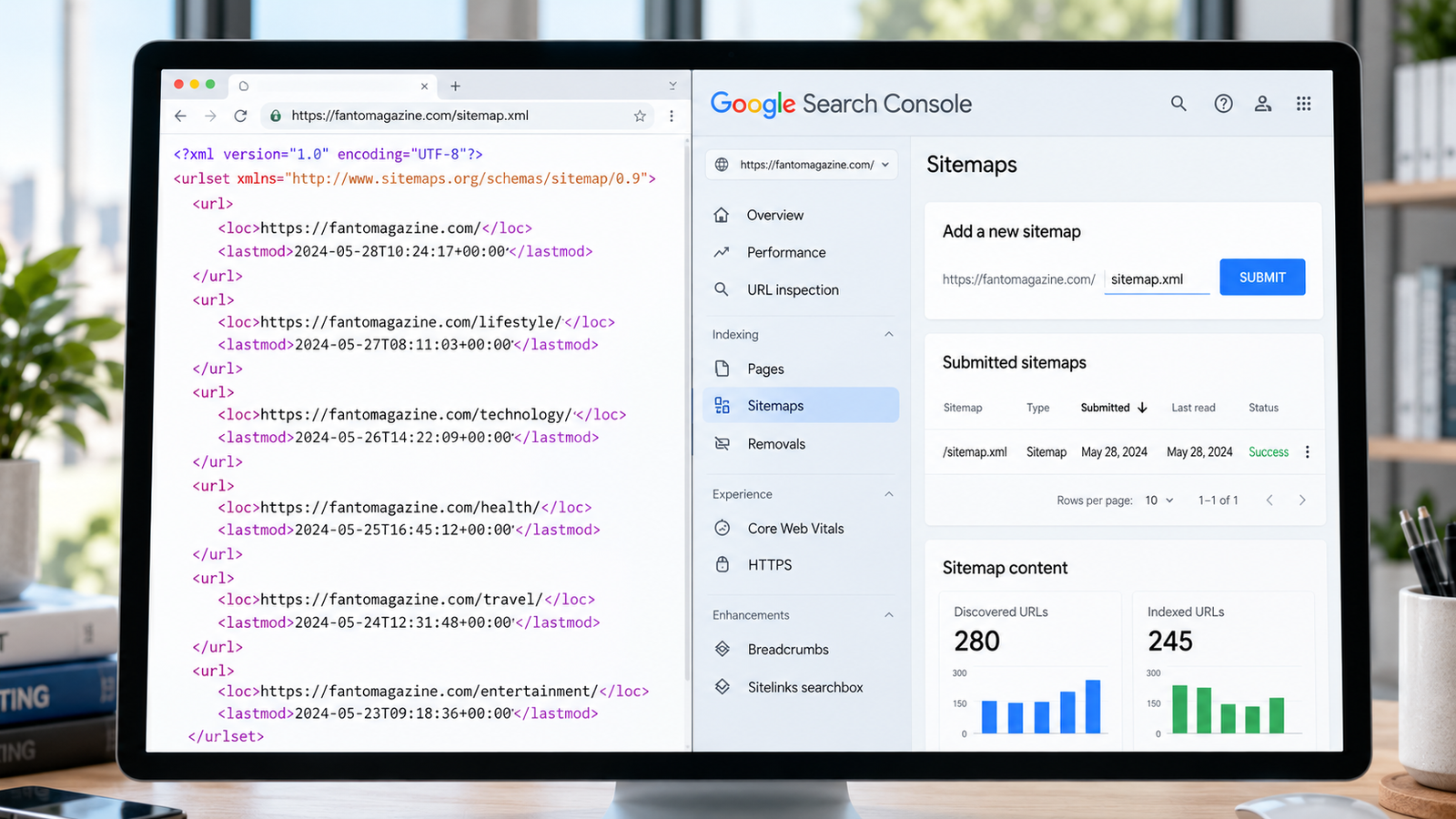
Ever wondered how a website keeps track of all its pages? Or how Google finds a brand-new article within hours of it going live? A big part of the answer is the sitemap. That’s why so many people search for the fentomagazine com sitemap. Some own the site, and others just want to see how a publication organizes its content.
In this guide, I’ll walk you through what a sitemap is, how to find the one for fentomagazine.com, and how to submit it to Google properly. If you’re still learning the technical side of SEO, you’ll find more practical tutorials over at Web AI Automation.
What Is a Sitemap and Why Does It Matter?
Think of a sitemap as a list of the important pages on your website. Most are written in XML, a format made for search engines rather than people. You can read the official format rules at sitemaps.org.
Key Benefits of a Sitemap
Here’s what a good sitemap does for you:
- It shows search engines which pages exist on your site
- It helps Google spot new or updated pages sooner
- It’s a big help for large sites, brand-new sites, and sites with weak internal linking
- It can carry extra details, like the date a page was last changed
An Important Limitation
Let’s be clear about one thing. A sitemap doesn’t force Google to crawl or index anything. It’s a helpful nudge, not an order. Google still makes its own call based on content quality, site structure and plenty of other signals.
About Fentomagazine.com
Fento Magazine is an online publication that explores social media reactions, public opinion, entertainment, news, and internet trends. Its About Us page explains how online conversations can influence the way people understand events and cultural discussions. If you’re researching the fentomagazine com sitemap, understanding the website’s content structure can help you explore its published pages more effectively.
A sitemap isn’t something you set up once and forget. For a site that publishes often, like a digital magazine, the fentomagazine com sitemap needs to stay in step with the content. Every new article should appear in the file, and deleted or redirected pages should drop out of it. When your sitemap matches your live pages, search engines waste less time on dead ends and can spend more of their attention on the content you actually want people to find.
How to Find the Fentomagazine com Sitemap
Every website handles its sitemap a little differently, so there’s no single guaranteed address. Work through these steps in order, and you’ll usually find it fast.
Step 1: Try the Most Common Sitemap URL
Open your browser and add /sitemap.xml after the domain name:
https://fentomagazine.com/sitemap.xml
If there’s a sitemap at that address, you’ll see either an XML file or a list of links.
Step 2: Try Other Common Variations
Different content management systems use different file names. If the first address doesn’t work, try these:
/sitemap_index.xml/wp-sitemap.xml/sitemap.xml.gz
Don’t be surprised if you land on a sitemap index. It doesn’t list pages directly. Instead, it points to smaller sitemaps, such as one for posts, one for pages and one for categories.
Step 3: Check the robots.txt File
Many sites mention their sitemap inside the robots.txt file. Go to:
https://fentomagazine.com/robots.txt
Look for a line starting with Sitemap:. The address right after it is the official sitemap location.
Step 4: Use a Google Search
Try searching for site:fentomagazine.com sitemap. Google may show sitemap pages it has already found. It’s less reliable than the first three steps, but it’s worth a quick look.
Step 5: Check the Website Footer
Some websites add a link to an HTML sitemap in the footer. That version is made for visitors, not search engines, but it can still show you how the site is laid out.
If you’ve tried all five and found nothing, the site may not have a public sitemap, or it may be hidden at an unusual address.
How to Read the Sitemap
Once the file is open, it can look a bit messy. Don’t worry, you only need to recognize a few tags:
<loc>is the full address of a page<lastmod>is the date the page was last updated<sitemap>shows up in an index file and points to another sitemap
Reading through it tells you which sections the site publishes most. If you’re doing competitor research, it’s one of the quickest ways to see how another site is built.
If you’re checking the fentomagazine com sitemap for research, take a few minutes to scan how its URLs are grouped. You’ll often notice patterns, like separate sections for articles, categories and static pages. These patterns show how the publication organizes its content and which topics it covers most. You can use that insight to improve your own site structure, spot content gaps, or simply understand how a regularly updated magazine keeps its pages easy for search engines to crawl.
How to Submit the Fentomagazine com Sitemap to Google
Here’s something a lot of guides leave out: you can only submit a sitemap in Google Search Console for a site you own or manage. If fentomagazine.com isn’t yours, you can’t submit its sitemap. You can still open it and study it, though. If you do own the site or you’re an authorized manager, here’s how to do it.
Step 1: Open Google Search Console
Head to Google Search Console and sign in with your Google account.
Step 2: Add and Verify Your Property
Add your website as a property. Google will ask you to prove it’s yours, usually through DNS verification or by uploading an HTML file. Finish the verification before moving on.
Step 3: Open the Sitemaps Report
In the left-hand menu, look under Indexing and click Sitemaps.
Step 4: Enter the Sitemap URL
You’ll see a box labeled “Add a new sitemap.” Type in the path to your sitemap there. For example, if your sitemap lives at https://fentomagazine.com/sitemap.xml, just enter sitemap.xml.
Step 5: Click Submit
Hit the submit button, and Google will go and fetch the file. It might take a short while, so be patient.
Step 6: Check the Status
Once it’s done, the report shows a status. “Success” means Google read your file without trouble. If you see “Has errors” or “Couldn’t fetch,” something needs fixing. Google’s own guide to building and submitting a sitemap covers this in more detail.
The good news is that you only need to submit it once. Google rechecks it from time to time, and you can resubmit after any major site changes.
Common Sitemap Errors and How to Fix Them
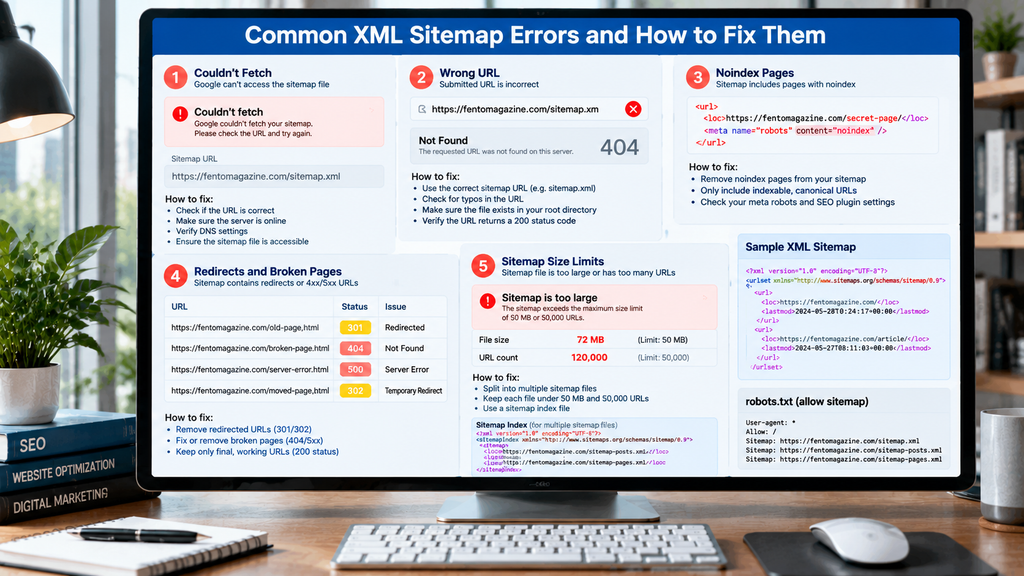
Sitemaps break sometimes. Here are the usual culprits and what to do about them.
Couldn’t Fetch Error
First, check that the URL opens in your browser. Then make sure robots.txt or a security plugin isn’t blocking it.
Wrong URL or Typo
It sounds silly, but it happens all the time. Double-check that you typed the exact path.
Blocked or Noindex Pages
If you’ve blocked a page from search or marked it noindex, keep it out of your sitemap. Mixed signals confuse search engines.
Redirects and Broken Pages
Only list live pages that load normally (a standard 200 status). Redirected or broken URLs just waste Google’s time.
Size Limits
One sitemap can hold up to 50,000 URLs or 50 MB uncompressed. If your site is bigger than that, split it into several files and tie them together with an index.
Sitemap Best Practices
A few simple habits will keep your sitemap working well.
Include Only Important, Indexable Pages
Leave out thin pages, duplicates and admin URLs. Your sitemap should show your best work.
Keep the Sitemap Updated
Most CMS plugins refresh it automatically whenever you publish something new, so you rarely need to touch it by hand.
Use Canonical URLs
Choose one version of your URLs, such as https with or without www, and stick with it everywhere.
Add the Sitemap to robots.txt
This lets every search engine find it, not only Google.
Support It with Strong Internal Linking
A sitemap helps Google find your pages, but internal links show which ones matter most. Want ideas? Check out the SEO guides on our blog.
Frequently Asked Questions
Where Is the Fentomagazine com Sitemap Located?
Most often it’s at /sitemap.xml on the domain. If it’s not there, check robots.txt or try /sitemap_index.xml.
Can I Submit Someone Else’s Sitemap to Google?
No. Search Console only lets verified owners and managers submit sitemaps for their own property.
Does Submitting a Sitemap Guarantee Indexing?
No. It helps Google discover your pages, but whether they get indexed depends on content quality and other factors.
How Often Should I Submit My Sitemap?
Once is usually enough. If your sitemap updates on its own, there’s no need to keep resubmitting it.
Is an HTML Sitemap the Same as an XML Sitemap?
Not at all. An HTML sitemap is for human visitors, while an XML sitemap is for search engines.
Conclusion
Finding the fentomagazine com sitemap isn’t hard once you know where to look. Start with /sitemap.xml, check robots.txt, and try the usual variations. If the site is yours, submitting the sitemap in Google Search Console takes just a few minutes and makes it easier for Google to discover your content. Keep the file clean, keep it current, and list only the pages you actually want people to find.