
AI moves away from chatbots and automation into more complex areas. Companies are utilizing the use of AI agents to perform monotonous tasks, interlink different software applications, serve customers, process information, and help their employees in day-to-day tasks.
However, selecting the right type of AI solution does not prove to be that easy for many companies. Generic software can fulfill the needs of most companies, but sometimes companies have unique workflow and processes which demand something different, and there is when custom AI agent development services may be helpful.
A custom AI agent is built keeping in view the workflow, information, applications, and goals of an individual company. Unlike other solutions, the workflow of a company need not necessarily be altered to fit in the generic software.
What Are Custom AI Agents?
A custom AI agent is an AI-based solution created to meet certain business needs. An agent has the ability to interpret commands, handle information, work with connected tools, and perform certain actions according to pre-set rules and business goals.
While a regular chatbot is supposed to answer questions posed by customers, an AI agent may be set up to perform some actions.
For instance, an agent may receive a customer’s message, analyze data within a business system, compose an answer, edit the record of this interaction, and alert a team member about the necessity to intervene.
Everything will depend on the technologies used within the system.
Why Do Businesses Need Custom AI Agent Development?
All organizations have different processes. Even if an ordinary AI application offers plenty of functionality, it does not know anything about the internal processes of an organization and its requirements.
Developing custom AI agents gives organizations the opportunity to design solutions based on their own needs.
Some typical motivations why organizations choose custom AI agents are:
Automation of boring administrative tasks
Enhancement of customer support processes
Connecting several business applications
Analyzing large business information volumes
Helping staff with boring research work
Lead qualification automation
Sales and marketing process automation
Data handling minimization
The point is not to replace staff. In most cases, it is better to leave decision-making to people and let AI deal with boring and repetitive tasks in a workflow.
How to Choose AI Agent Development Services
When choosing an AI software developer, price comparison is not sufficient. The developer chosen must have knowledge about the AI technology as well as the problem you want to solve.
Below are some key steps to be taken.
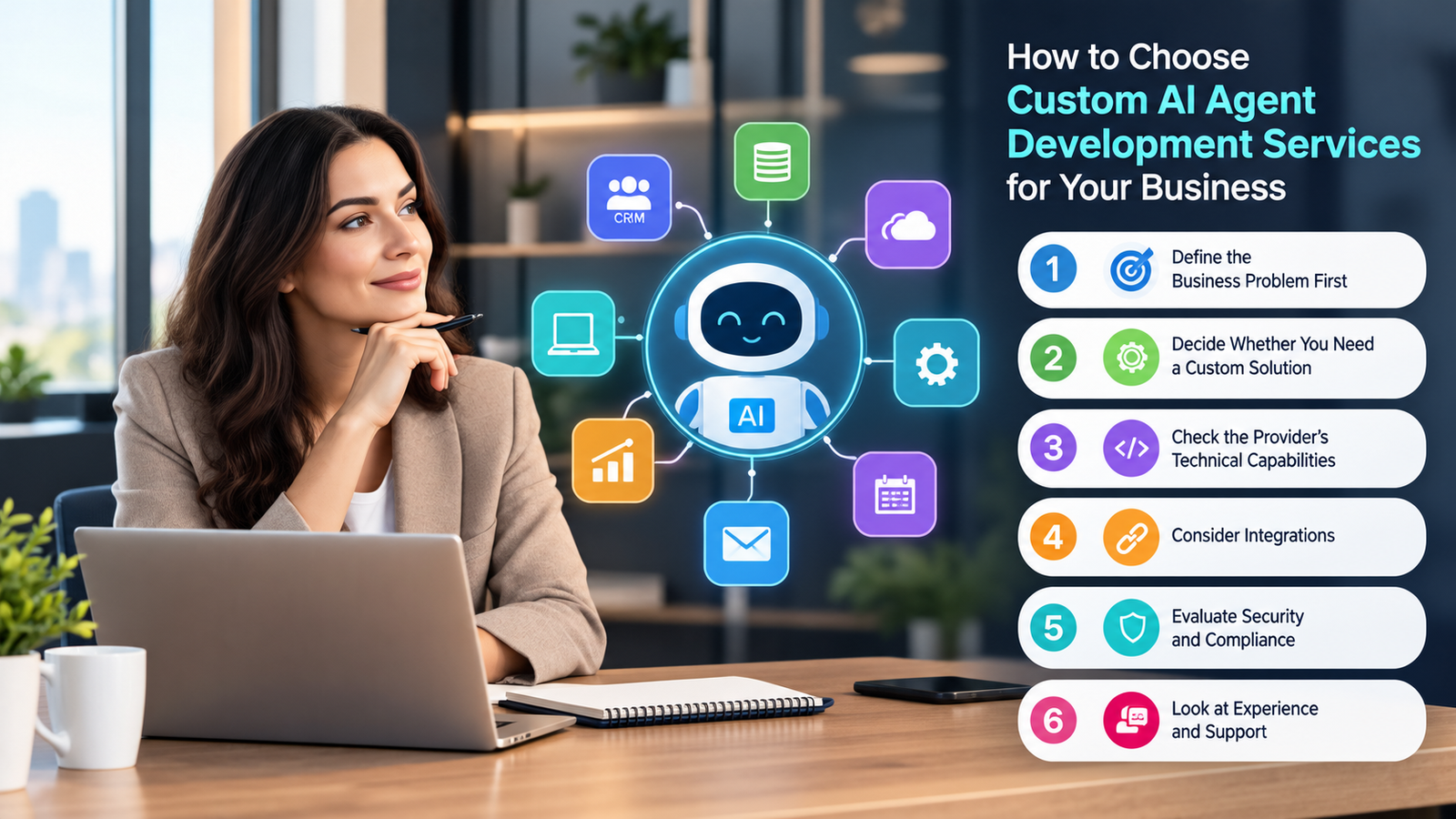
1. Define the Business Problem First
Prior to searching for AI agent development services, you need to identify the workflow that needs improvement.
AAsk yourself the following:
Which process is currently taking too long?
Which processes are repetitive?
Where are employees spending time performing manual work?
What information does this process need?
Which systems are involved?
When is human approval required?
Instead of “We need an AI agent,” the company may pinpoint a particular problem, such as manual review of leads coming in and allocating them to the right salesperson.
Defining the problem helps to simplify the development process significantly.
2. Decide Whether You Need a Custom Solution
This does not mean, however, that all enterprises require such an individual approach to the creation of artificial intelligence technology.
In case your requirements are rather basic, the existing system of AI automation can fit perfectly well. The development of a custom solution will be more reasonable if there are business-specific algorithms, proprietary data, numerous integrations, etc.
The service provider must make sure first whether you really need to develop custom AI technology.
3. Check the Provider’s Technical Capabilities
In comparing custom AI agent development services, you must consider the technologies and features that the development team can implement.
These could include:
Large language models
AI agent frameworks
APIs and third-party integration
Database
Automated business platforms
Authentication methods
Cloud platform
Data security
Monitoring and analytics
It is also important to determine how the system will integrate with the rest of the software that your company currently utilizes.
While an AI agent can be very capable in itself, much of its commercial usefulness lies in its ability to integrate with other systems.
4. Consider Integrations
An effective AI agent is not likely to function in a vacuum.
It may require communication with such things as the CRM, help desk, e-mail client, project management application, database, calendar, payment system, or internal application, depending on the industry.
For instance, an AI sales agent can be required to collect data from the CRM, qualify the lead, generate the record, and notify the salesperson about this.
Prior to development, prepare a list of applications that the agent is supposed to use.
Common Use Cases for Custom AI Agents
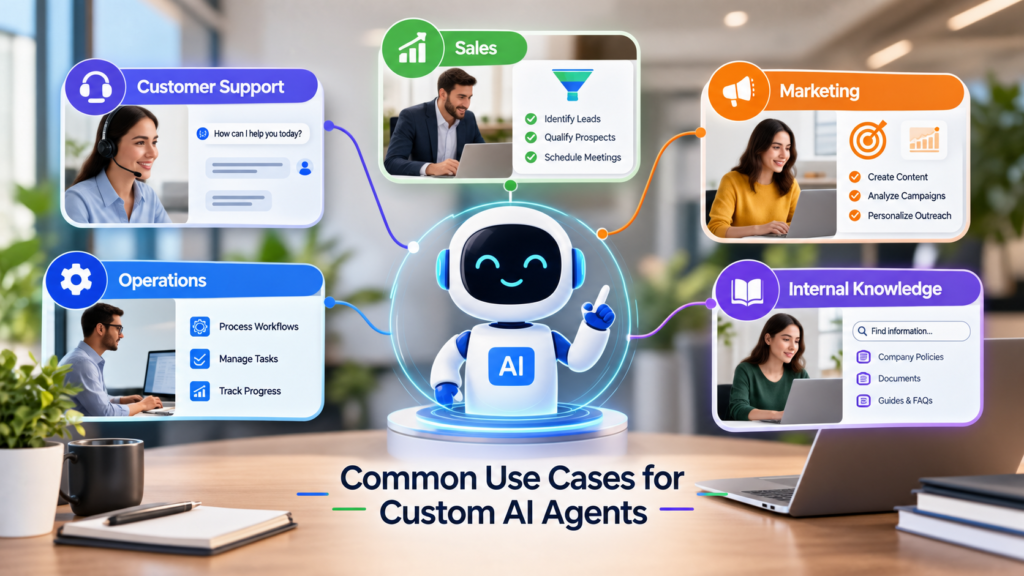
There are many applications for AI agents in the business setting as corporations try out more sophisticated ways of automation.
Customer Support
An AI agent could provide support by helping with routine customer queries, accessing information, classifying queries, and forwarding complicated cases to human agents.
Sales
A sales AI agent would help with leads identification, research, follow-ups, and updates on customer data.
Marketing
Marketing teams can use AI agents to assist with research, content workflows, reporting, audience analysis, and campaign-related tasks.
Operations
In marketing, an AI agent could help with research, creation of content, generation of reports, and other marketing-related tasks.
Internal Knowledge
Corporations could use AI agents to control workflow processes, transfer information, generate reports, and help with repetitive operations.
Custom AI Agents vs. Standard AI Tools
The biggest difference is flexibility.
| Feature | Standard AI Tool | Custom AI Agent |
|---|---|---|
| Setup | Usually faster | Requires development |
| Customization | Limited to available features | Designed around specific requirements |
| Integrations | Supported integrations | Can be built around required systems |
| Business logic | General | Customized |
| Scalability | Depends on provider | Can be designed for specific growth needs |
| Initial cost | Often lower | Usually higher |
| Control | Limited | Greater control over workflows |
A standard tool may be enough for straightforward tasks. A custom solution becomes more attractive when a business needs deeper integration and greater control.
Businesses can also use AI to streamline repetitive SEO workflows while keeping quality and human oversight in place. SEO automation can help automate routine optimization tasks and make ongoing website management more efficient.
Security and Human Oversight Matter
It would be wrong to regard the use of AI for automation as something totally hands-off.
The firm needs to think about the extent of the data that an AI agent can access, the actions it can carry out, and whether any human authorization is necessary.
Extra control might be needed for sensitive processes; things like permission, logging, limited access, validation, and human checking might be part of that process.
For instance, an AI agent can draw up a report on finances, but a person has to check this before any action can be taken.
How Much Does Custom AI Agent Development Cost?
There is no universal price for developing an AI agent from scratch.
The cost of development might vary depending on a number of factors, including:
Workflow complexity
Integration points
AI models to be used
Data needs
Security needs
User interface needs
Deployment and testing
Maintenance
An internal agent can cost significantly less than an integrated system with complex workflows.
This is why companies need to understand their needs and get a project-specific quote.
Questions to Ask an AI Development Provider
Ask the right practical questions before choosing a provider for your project.
For instance:
Do you have prior experience developing such AI agents?
What AI models and technologies do you employ?
How is the agent supposed to integrate into our systems?
How will you protect our business data?
What actions will need human authorization?
How will you test the system?
How will you monitor its performance after release?
What kind of support and maintenance will be provided?
These answers will show if the provider has thought of the project beyond the development phase.
Final Thoughts
These AI-enabled agents provide organizations with a more versatile way of automating tasks by incorporating AI technology with their business processes and existing software programs.
The trick lies in identifying an actual problem with the business first and not deciding on the technology just because it is in fashion. The moment the workflow is identified, it will then be easy to establish whether a generic solution will do the job or whethercustom AI agent development services are a better fit.
When properly designed, an AI agent is supposed to streamline the process but also maintain proper oversight, security, and reliability. Given the proper development approach, the AI agent will be transformed from an abstract technological project into something that makes sense for today’s business environment.
TuARLExHNfhARKUyGQdL