

Every sales team knows the feeling. Fifty new leads arrive, and nobody is sure which five are worth a call today. Reps pick at random or chase whoever replied last. Meanwhile, a buyer who was ready to purchase waits two days for an answer and signs with a competitor.
AI lead scoring is built to fix this problem. It reads your past sales data, finds the patterns behind your best customers, and ranks new leads by how likely they are to buy. Your team then starts the day with a clear list instead of a guess.
This guide explains what AI lead scoring is, how it works, where it helps most, and how to start. It uses plain English and no hype.
What Is AI Lead Scoring?
Lead scoring gives every lead a number that shows how promising it is. A high score means “talk to this person now.” A low score means “keep nurturing for now.”
There are two ways to build that score.
Manual (rules-based) scoring. You decide the rules yourself. For example, a demo request might earn 20 points, and an unsubscribe might subtract 10. The numbers above are only an example, and every business sets its own.
AI lead scoring. A machine learning model studies your real history of won and lost deals. It finds which traits and behaviors usually come before a sale, and it scores new leads against those patterns. As more deals close, the model can use those new outcomes to refine future predictions, depending on the platform and its update or retraining settings.
The big difference is who finds the patterns. With manual scoring, people guess which signals matter. With AI lead scoring, the data shows which signals matter.
Lead scoring is also different from lead qualification. Qualification determines whether a prospect meets your business requirements, while scoring helps prioritize prospects based on their potential to convert. You can learn more in our guide to AI Lead Qualification.
Why Manual Lead Scoring Often Falls Short
Manual scoring is a fine place to start, but it has limits.
- It rests on opinions. Sales and marketing may disagree about what makes a good lead, and the points often reflect that argument.
- It goes stale. Your market and your buyers change, but the rules stay the same until someone edits them.
- It misses hidden patterns. A human might not notice that leads from one industry who visit your pricing page twice close far more often.
- It is slow to maintain. Every change needs someone to review, rewrite, and test the rules.
AI lead scoring does not remove the need for human judgment. It does take away much of the guesswork and routine upkeep.
How AI Lead Scoring Works
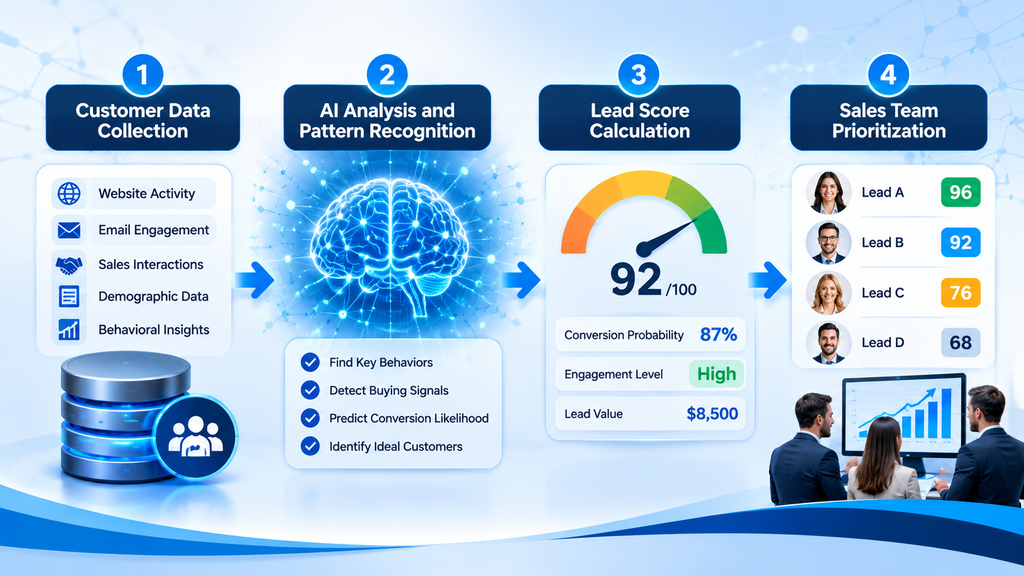
The process is easier to follow in four steps.
1. It gathers your data. The model looks at the leads and customers already in your CRM. This usually includes company details, job titles, form fills, email activity, page visits, and the outcome of each deal.
2. It learns from past results. The model compares leads who became customers with leads who did not. It looks for the traits and actions that tend to separate the two groups.
3. It scores new leads. Each new lead is compared against those patterns. The closer a lead looks to your past winners, the higher the score.
4. It keeps improving. As new deals are won or lost, that fresh information can be used to refine future scores. Whether this happens automatically or through scheduled model retraining depends on the platform.
Major CRM platforms already offer this. Salesforce explains its approach in a Trailhead module on Einstein scoring in Account Engagement, and HubSpot describes how its predictive scoring estimates a contact’s likelihood to close in its official knowledge base. Features, names, and plan requirements change over time, so check each provider’s current documentation before you decide.
What Data Does AI Lead Scoring Use?
Scoring models usually combine two kinds of signals.
Fit data tells you whether a lead looks like your ideal customer:
- Industry
- Company size
- Job title
- Location
Behavior data shows how interested the lead is right now:
- Pages visited, especially pricing or product pages
- Emails opened and links clicked
- Forms submitted or demos requested
- Content downloaded
- Replies and meetings booked
Email opens should be treated cautiously because privacy features, image preloading, and automated email activity can affect tracking accuracy. Clicks, replies, and other meaningful actions can provide additional context.
Fit tells you who someone is. Behavior tells you what they are doing. A strong score usually needs both. A perfect-fit company that never engages is not urgent, and a very active visitor from a poor-fit company may not be worth long calls.
Key Benefits of AI Lead Scoring
1. Sales reps spend time on the right people
When leads are ranked, reps start with the ones most likely to buy. This helps most on teams that get more leads than they can handle.
2. Faster follow-up
Speed matters when someone shows interest. A clear priority list helps your team reach hot leads while they are still paying attention.
3. Better teamwork between sales and marketing
A shared score gives both teams one definition of a “good lead.” Marketing can see which campaigns bring leads that actually close, not only leads that fill a form.
4. Less guesswork and less bias
Rules written by people can carry personal opinions. A model built on real outcomes depends more on evidence, though it still needs checking (more on that below).
5. Smarter marketing spend
When you see which sources and behaviors lead to sales, you can put more budget into what works. This also supports your wider conversion rate optimization work, since you learn which visitors turn into customers and why.
A Simple Example
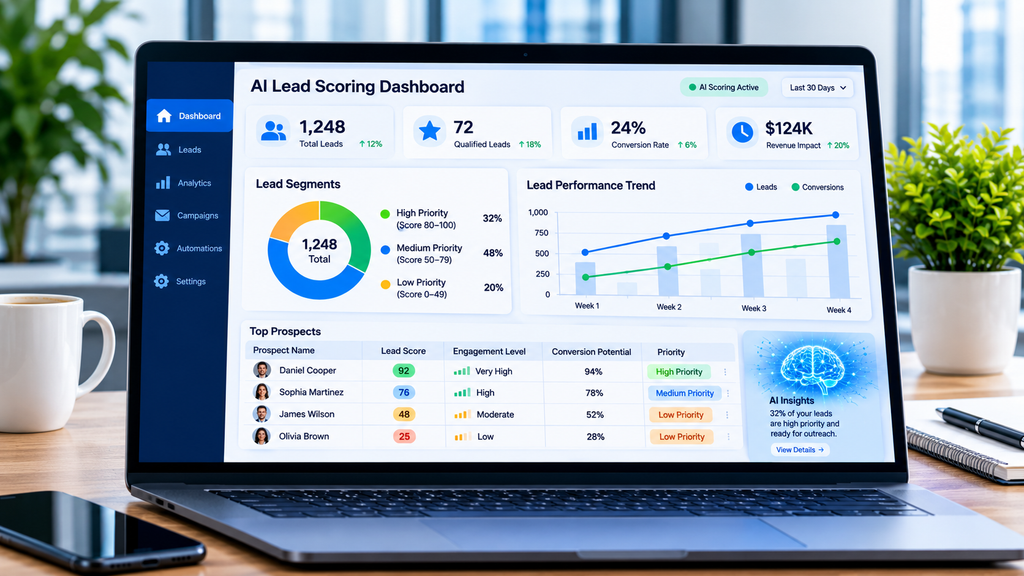
Imagine a software company that receives 200 new leads in a week.
- Lead A works at a mid-sized company in the target industry, visited the pricing page three times, and asked for a demo.
- Lead B downloaded one free guide and has not returned.
- Lead C is a student who opened one email.
Under a basic first-come, first-served approach, a rep might call Lead C first just because the form arrived earlier. With AI lead scoring, Lead A moves to the top, Lead B enters an email nurture sequence, and Lead C gets low priority. The same team now spends its energy where a sale is most likely.
This is a made-up example to show the idea, not a real company’s result.
How to Get Started With AI Lead Scoring
You do not need a large project to begin. Follow these steps in order.
Step 1: Define a “good lead.” Sit down with sales and agree on what a qualified lead looks like. Decide what counts as a conversion, such as a booked demo or a closed deal.
Step 2: Clean your CRM data. A model can only learn from what it is given. Remove duplicates, fill missing fields, and make sure won and lost deals are recorded correctly. Poor data gives poor scores.
Step 3: Check how much data you have. Most predictive tools need enough past leads and closed deals to find patterns. Each provider sets its own requirements, so read them before you buy anything. If you have very little history, start with manual scoring and move to AI later.
Step 4: Pick a tool you already have access to. Many CRMs include predictive scoring, sometimes only on higher-priced plans. Check your current plan first before paying for a separate product.
Step 5: Connect scores to action. A score that nobody uses is just a number. Set up rules such as “notify the sales rep when a lead passes a certain score.” This is where automation pays off, and our guide on how intelligent automation works in business shows how to connect steps like this without extra manual work.
Step 6: Test, review, and adjust. Compare high-score leads with actual results every month or so. If the scores do not match reality, fix your data or your goals.
Common Mistakes to Avoid
- Trusting the score blindly. A score is a guide, not a verdict. A rep who knows the buyer may spot something the model cannot.
- Using bad data. Messy records lead to misleading scores.
- Never reviewing the model. Markets change. A model that worked last year may drift.
- Keeping sales out of the process. If reps do not trust the score, they will ignore it. Ask for their feedback early.
- Ignoring privacy rules. If you collect and use personal data, follow the laws that apply to your audience. For people in the UK, this includes UK GDPR and the Data Protection Act 2018. For people in the EU, EU GDPR applies. In the US, state privacy requirements vary, including California’s CCPA as amended by the CPRA. Ask a qualified professional if you are unsure.
- Expecting instant results. Models improve with data and time, so give the system a fair trial period.
Is AI Lead Scoring Right for Every Business?
Not always. It works best when you have a steady flow of leads, a record of past deals, and a sales team that cannot call everyone. If you only get a handful of leads each month, a simple manual checklist may serve you better and cost less.
For larger or fast-growing teams, AI lead scoring can save real time. It is one example of a wider shift in how teams operate, which we cover in how AI and automation are changing the way we work.
Frequently Asked Questions
What is AI lead scoring in simple words?
It is a method that uses machine learning to rank your leads by how likely they are to become customers, based on your past sales data.
How is it different from traditional lead scoring?
Traditional scoring uses rules a person writes. AI lead scoring finds the patterns itself from historical data and can update as new results come in, depending on the platform.
Do I need a lot of data?
Usually you need a fair amount of past leads and closed deals for a model to find reliable patterns. The exact requirement depends on the tool, so check your provider’s documentation.
Will AI replace my sales team?
No. It helps your team decide whom to contact first. People still build relationships, answer questions, and close deals.
Is AI lead scoring only for big companies?
No, but it fits best where lead volume is high enough to make prioritizing hard. Smaller teams can start with manual scoring and upgrade later.
How accurate is it?
Accuracy depends on the quality and amount of your data, and no model is perfect. Treat scores as a strong hint and review results regularly.
Final Thoughts
AI lead scoring will not close deals for you, but it helps your team spend its limited time on the leads that matter most. Start by defining what a good lead looks like, clean your data, use the tools your CRM already offers, and review the results often. Small, steady improvements in who you call first can add up to a better pipeline over time.