

Artificial intelligence has quickly become part of work, education, coding, research and content creation. Two of the widely discussed AI assistants are Claude from Anthropic and ChatGPT from OpenAI. Both can write, analyze information answer questions, assist with coding and support workflows but their features and user experiences are not identical.
The Claude AI vs ChatGPT discussion is therefore less, about finding one winner and more about understanding which tool fits a particular task. Both platforms continue to receive updates making their capabilities increasingly broad. Zapier’s 2026 comparison also notes that the leading models have reached a close level of capability while their specialized features and workflows remain important differences. Zapier’s 2026 comparison also notes that the leading models have reached a close level of capability while their specialized features and workflows remain important differences.
Claude AI vs ChatGPT Comparison at a Glance
The claude ai vs chatgpt comparison becomes easier when the major features are viewed side by side.
| Feature | Claude | ChatGPT |
|---|---|---|
| Developer | Anthropic | OpenAI |
| Free plan | Yes | Yes |
| Web search | Yes | Yes |
| Coding assistance | Claude Code | Codex |
| Long-context work | Up to 1M tokens depending on model | Up to 1M tokens depending on model and plan |
| Image generation | Not its primary consumer feature | Available |
| Voice features | Available | Available |
| File and document work | Yes | Yes |
| Deep research | Available | Available |
| Advanced automation | Claude Cowork and related tools | Agent and workspace features |
| Paid individual plans | Pro and Max options | Multiple paid options |
| Main strength areas | Writing, coding, analysis and long-form work | Broad AI toolkit and multimodal workflows |
The exact features available can depend on the model, plan, region, and ongoing product updates. Claude currently offers Free, Pro, and Max individual plans, while ChatGPT also has multiple subscription levels.
Claude AI Features and Performance
One important part of the claude ai vs chatgpt discussion is Claude’s focus on writing, reasoning, coding, and handling large amounts of context.
Claude can help users brainstorm ideas, create content, analyze documents, generate code, search the web, create files, and execute code. Anthropic currently lists web search, memory, file creation, code execution, connectors, and extended thinking among its capabilities.
Claude has also expanded beyond traditional chatbot conversations. Anthropic recently introduced document, presentation, and visual-work capabilities, allowing users to create and export documents and presentations from Claude.
For writers, this can be useful when a project requires maintaining context across a long document. For developers, Claude Code provides a dedicated coding workflow that goes beyond simply generating individual snippets.
ChatGPT Features and Performance
I see another main part of the Claude AI vs ChatGPT comparison is ChatGPTs ecosystem.
ChatGPT can help with writing, coding, research, file analysis, voice conversations, image generation and many other AI assisted tasks. The wide range of ChatGPT features helps people who want AI tools inside a single platform.
Zapiers 2026 comparison points out image generation custom AI experiences, workflows, coding tools and integrations as key parts of ChatGPTs ecosystem.
For users who often switch between tasks having many capabilities, inside one interface can make the workflow easier. For example a user might research a topic organize the information create content analyze a document and produce material all in the same project.
Claude AI vs ChatGPT for Coding
For developers, the claude ai vs chatgpt question often comes down to the type of programming workflow they prefer.
Claude provides Claude Code for software development tasks. It can help developers understand existing codebases, make changes, troubleshoot problems, and work through larger coding tasks.
ChatGPT provides coding capabilities through its own development tools and Codex-related workflows. These can be useful for generating code, debugging, explaining programming concepts, and supporting development projects.
The difference is not just, about whether one platform can code and the other cannot. Both are capable of handling programming tasks. The real distinction lies in how each platform matches a developers usual way of working the tools they prefer how their projects are structured and what limits apply to usage.
Zapier’s 2026 review specifically identifies coding as an area where Claude has developed a strong dedicated workflow, while ChatGPT offers coding as part of its broader AI toolkit.
Claude AI vs ChatGPT for Writing
Writing is another area where the comparison between Claude AI and ChatGPT really matters for bloggers, marketers, students and business users.
Claude tends to be favored for long-form writing tasks. It works well for rewriting text, brainstorming ideas editing drafts and turning information into clean polished content. Its ability to handle context windows makes it especially helpful when working with lots of source material or complex documents.
ChatGPT also creates a range of written content—articles, outlines, emails, marketing copy, summaries, social media posts and more. It often stands out because of its toolset allowing users to mix writing with research, image generation file analysis and other AI-powered functions.
Neither tool delivers flawless content on its own. Users must still check facts, review tone, verify citations and edit the output before sharing anything
For SEO professionals the best strategy is to see AI as a helper, not a replacement. Search-intent analysis original research, editorial judgment and optimization still depend heavily on effort. AI can speed things up. It cannot replace the strategic thinking, behind effective content.
Claude AI vs ChatGPT for Students
For students the Claude AI vs ChatGPT comparison can involve research, explanations, brainstorming, study notes, summarization and writing assistance.
Claude can help students understand concepts. Claude can also summarize documents. Claude can organize information. Claude can work through questions. ChatGPT can provide educational support. ChatGPT can also offer a range of interactive features.
Students should also understand the rules of their school, university or before using AI for assignments. AI-generated answers can contain mistakes so students should check academic information, against reliable sources.
If you are specifically researching student pricing or promotional opportunities for Claude, see our guide on Claude Student Discount Savings and Risks.
Claude AI Pricing vs ChatGPT Pricing
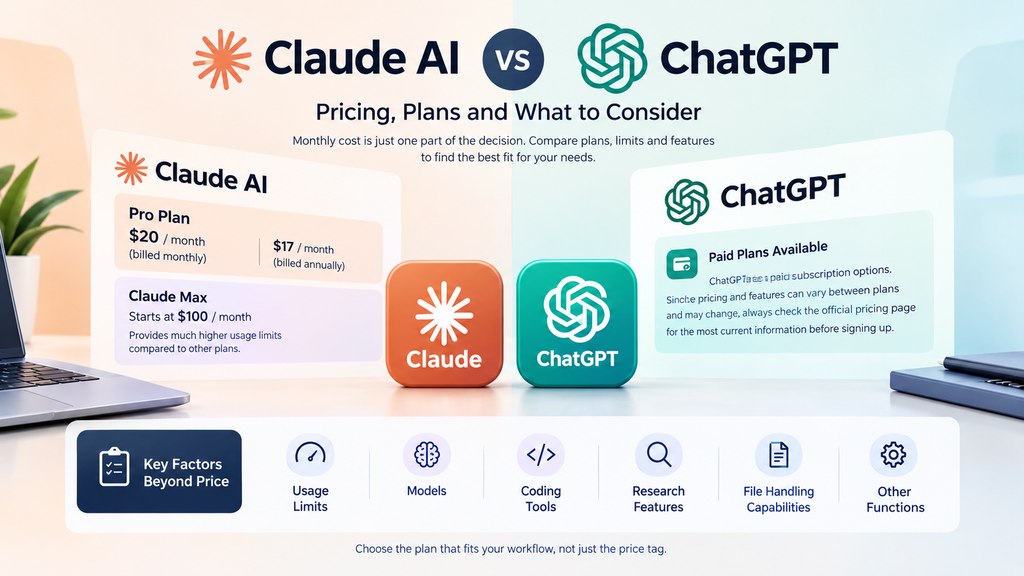
Pricing is a factor when deciding between Claude AI vs ChatGPT because plans, limits and features can change over time.
Claude currently offers a plan. Its Pro plan costs $20 per month if billed monthly or $17 per month with billing. The Claude Max plans start at $100 per month. Provide much higher usage limits compared to other plans.
ChatGPT also has paid subscription options. Since pricing and features can vary between plans and may change users should always check the pricing page for the most current information before signing up.
Of focusing only on the monthly price think about what you actually need. Consider usage limits, models, coding tools, research features, file handling capabilities and other functions that matter to you. These factors can make a difference, in the real-world experience.
Claude AI vs ChatGPT for Everyday Workflows
The claude ai vs chatgpt decision can also depend on how you work every day.
For long-form writing and extensive document analysis, Claude can be useful because of its large context capabilities and writing-focused workflow. For coding, users may prefer Claude Code or ChatGPT’s coding environment depending on their development process.
ChatGPT can be useful when a workflow requires several different AI capabilities, particularly when text generation needs to be combined with image creation, file analysis, research, or other tools.
Both platforms can also be incorporated into broader automation workflows. Zapier’s 2026 comparison notes that both Claude and ChatGPT can integrate with Zapier, allowing users to connect AI workflows with other applications.
For more information about using AI tools for content-related tasks, you can also read our guide on ChatGPT Watermark Remover.
Claude AI vs ChatGPT for Different Users
The choice between Claude AI and ChatGPT can look different depending on what the user wants.
For writers: I find Claude AI can be useful, for long‑form drafting, editing, brainstorming and working with big source material. I find ChatGPT can be useful when writing is combined with AI features.
For developers: I see both Claude AI and ChatGPT provide coding capabilities. I see Claude Code and ChatGPT coding tools can support debugging, code generation, analysis and development workflows.
For students: I think both Claude AI and ChatGPT can help with explanations, summaries, brainstorming and research support provided that their use follows policies.
For businesses: I believe both Claude AI and ChatGPT provide features that can support content creation, research, analysis, automation and team workflows. I believe the right option depends on the organizations requirements, budget, integrations and security expectations.
For users: I think a user who wants a broad collection of AI capabilities may value ChatGPTs wider feature ecosystem while a user focused heavily on writing, coding or long‑context work may want to explore Claude AI.
Frequently Asked Questions
Is Claude better than ChatGPT?
The claude ai vs chatgpt comparison does not have one universal answer because the two platforms emphasize different features and workflows. The better fit depends on the user’s specific tasks, preferred interface, available plan, and required tools.
Which is better for coding Claude or ChatGPT?
Both can assist with coding, debugging, explanations, and software development. Claude offers Claude Code, while ChatGPT provides its own coding tools. The practical choice depends on the development workflow and features the developer needs.
Which AI is better for writing?
Both can produce and edit written content. Claude is particularly suited to long-form and context-heavy work, while ChatGPT offers writing alongside a broader collection of AI features. Users should test both with their own content requirements.
Is Claude cheaper than ChatGPT?
Pricing changes frequently and depends on the selected plan. Claude currently lists Pro at $20 monthly or $17 monthly with annual billing, while higher Max plans start at $100 monthly. Users should compare the current plans before purchasing.
Which AI is better for students?
Both can support learning, explanations, summaries, brainstorming, and research. Students should compare available features and usage limits while following their institution’s AI policies.
Can I use Claude and ChatGPT together?
Yes. Using both can be practical when different tasks benefit from different workflows. For example, one platform can be used for a first draft while the other is used for reviewing, restructuring, brainstorming, or another stage of the project.
Final Thoughts
The debate between Claude AI vs ChatGPT shows how fast AI assistants are changing. Both Claude and ChatGPT now offer abilities in writing, coding, research analyzing documents and helping with daily tasks. Their features keep improving. The differences between them keep shifting.
Than looking for a single winner people should look at what they need. Think about the pricing how much you can use each tool the models available whether the tools work with other apps the coding support, research options and the kind of work or content you plan to make.
For users trying both platforms with real tasks can give better results than reading general comparisons. As AI keeps growing through 2026 the best choice might not be about which chatbot has the name. It will be, about how its features match your own way of working.
One thought on “Claude AI vs ChatGPT: Which Is Best for You in 2026?”