
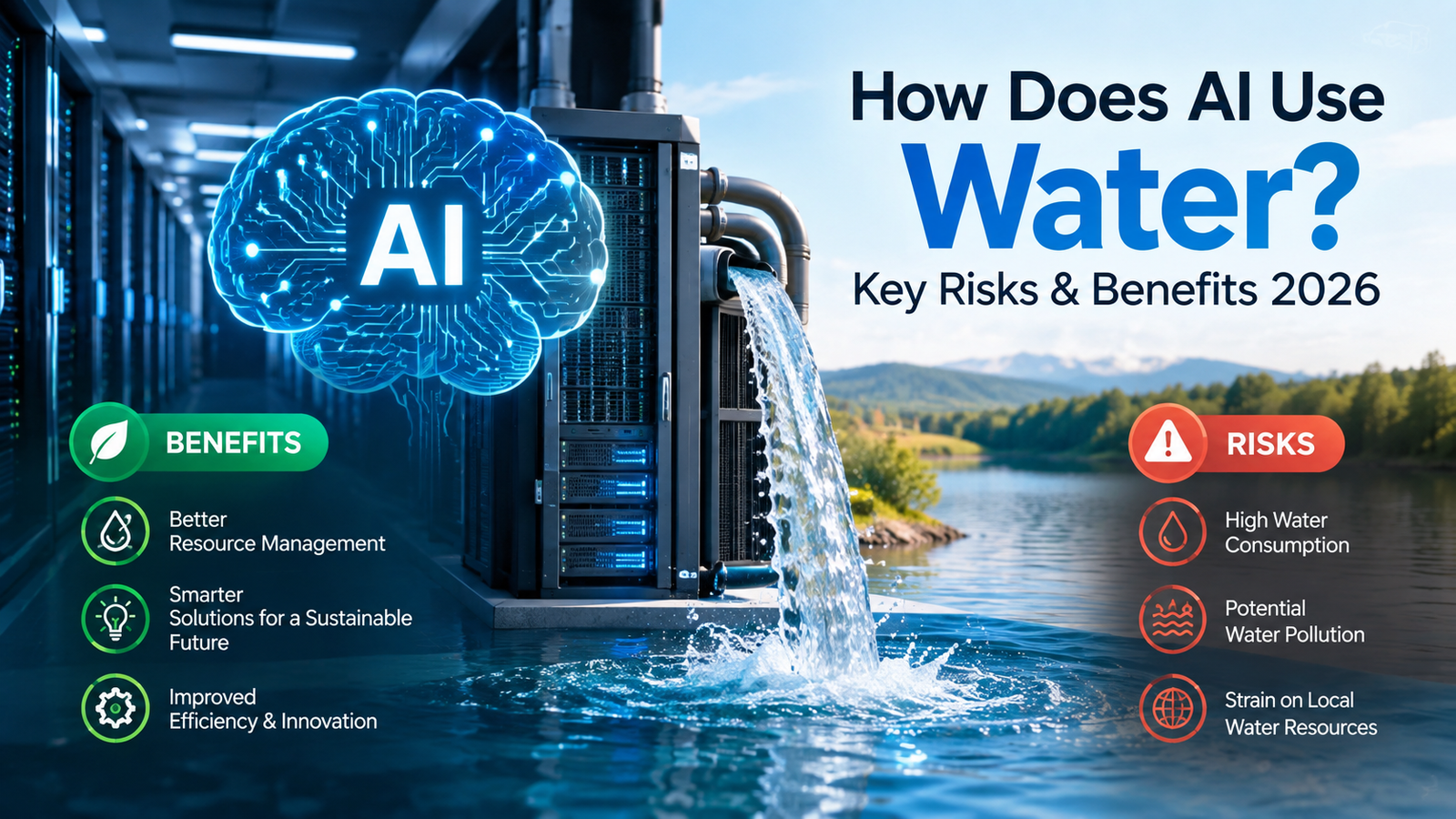
Artificial intelligence looks digital but each AI model relies on the physical infrastructure. Servers that are highly efficient run inside data centers, use electricity and generate heat. They require cooling, and that’s where water enters the image.
How does AI use water? AI doesn’t directly use water when you write an instruction. Instead the data centers which handle AI workloads might use water to cool, whereas the generation of electricity and manufacturing of hardware may result in indirect demands for water.
This guide will explain how AI uses water and the amount of water AI might use, what is the impact on this of water used, and what companies can do to reduce their footprint on water.
How Does AI Use Water?
AI systems make use of water mostly due to the fact that the hardware they run produces heat. The process of training and running large models require high-performance GPUs as well as other processors. Electricity power these components and a large portion of this energy will eventually turn into heat.
Data centers need to eliminate this heat in a continuous manner. Certain facilities employ cooling towers, as well as evaporative cooling. In this method, water assists in transferring heat as well as some of it evaporates. Others utilize chilled-water system, air conditioning and direct liquid cooling.
In simpler terms how does AI use water? The AI model does not require water. The infrastructure that supports it could use water to keep the computer equipment operating at safe temperatures.
Why Does AI Need So Much Cooling?
Modern AI workloads could put long-term demands on computers. The training of large models can keep a large number of processors in operation for long durations, while the most well-known AI services can handle huge amounts of requests. This raises an important question: how does AI use water?
High-density computing generates a lot of heat. If administrators aren’t able to eliminate this heat, servers may be slow to respond, fail, or be damaged.
This is why water use in AI facilities is mostly concerned with thermal management. Water is a great way to transfer heat, making it a good choice for cooling industrial processes.
Certain facilities employ evaporative cooling because it eliminates huge amounts of heat. Other facilities are implementing liquid cooling, which brings cooler fluid closer to the chips that generate heat.
How Much Water Does AI Use?
There isn’t a single figure that can be used to calculate AI usage of water. The estimates published by researchers vary as they evaluate different locations, workloads cooling systems, locations, and the types of water used.
A peer-reviewed study from 2025 discovered that data center workload water usage can differ by over 10,000 times. It identified server efficiency the use of electricity-related water servers’ utilization, cooling technology infrastructure efficiency temperature servers that are inactive, as well as refresh cycles of hardware as crucial aspects.
It makes statements such like “one AI prompt always uses X amount of water” false. The outcome is contingent on where the computation takes place and the way in which the facility handles heat.
When people inquire about how AI use water, they usually anticipate a specific amount per question. In actuality, AI water usage is more easily understood as a system-wide footprint.
Direct vs. Indirect AI Water Consumption
Understanding how does AI use water is a matter of separating two main operational components.
Direct Water Use
Direct water usage occurs in the Data Center. Cooling towers could be consuming water through evaporation and other systems may require water to transfer heat or cosmetic water, treatments or for humidification.
Veolia states that the servers that are packed tightly generate a lot of heat, and industrial cooling systems consume large amounts of water. The company also outlines data centers that cut down on water consumption through improved cooling water treatment.
Indirect Water Use
Indirect water use happens outside the facility, particularly by electricity generation. Power plants use water based on the technology used to generate them and their the location of their facility.
An analysis of 2025 found that the majority of worldwide data center water consumption in 2023 was attributed to indirect water usage generated by electricity instead of direct cooling on-site.
Thus cutting down on direct cooling water doesn’t necessarily eliminate the larger environmental footprint that AI has on water.
How AI Uses Water in Data Center Cooling
How does you use water in the data center and How does AI use water?
Servers produce heat when processing data. Cooling equipment transfer heat away from hardware. In evaporative systems, water absorbed heat and then evaporates. In chilled-water systems, the water or other cooling fluids can be circulated via heat exchangers.
Cooling towers are commonplace in large buildings. They absorb heat and release it out into the air, utilizing an evaporation process that removes a part all the heat. Facilities will then replenish the water that is lost from the system.
To get a real-world look at the way data centers handle water-intensive cooling, refer to this water management for data centers along with this AI water management resource. This guide can help you to know how does AI use water?
Direct liquid cooling employs a different method. The liquid coolant is moved closer to the components that generate heat instead of relying on the air around it. This may help with high-density AI infrastructure, and could lower the dependence on water-intensive cooling systems.
The most effective approach is based on the weather and hardware, design of the facility and energy systems, as well as the local water conditions.
What Factors Affect AI Water Usage?
A variety of factors affect water consumption:
Technology for cooling: Evaporative cooling creates various water demands in closed or dry loop cooling.
Climate The heat of the environment can create more cooling demands as cooler conditions aid in heat rejection.
Source of electricity: The water footprint of electricity is different between technology and location.
Efficiency of the server: Hardware that is more efficient can run more calculations using less power and heat.
Place: Water availability matters due to the fact that the local impacts can vary greatly between an area with abundant water and an area that is water stressed.
These reasons show why AI and water consumption can’t be reduced to a single global amount.
How Companies Can Reduce AI Water Consumption
Businesses that operate an AI infrastructures are able to take a variety of practical steps for how does AI use water.
Improve Cooling Efficiency
Operators can adjust airflow, cooling control as well as heat exchange and server location. Direct liquid cooling systems that are suitable for direct use can also assist in managing high-density computing.
Reuse and Recycle Water
Water treatment systems enable the reuse of cooling water over longer durations. Veolia has a case study where an improved cooling-water treatment system helped save 12 million gallons of water annually.
Choose Locations Carefully
Companies should think about water availability, climate as well as electricity infrastructure and the needs of communities prior to creating or expanding data centers.
Improve Hardware Efficiency
The more efficient processors will decrease the power needed to run computation. A lower use of electricity can decrease the heat that cooling systems have to remove.
Reduce Indirect Water Use
Because electricity generation can contribute to the consumption of water in data centers choosing less water-intensive sources of power can lessen the overall footprint.
Measure Water Transparently
Companies require accurate measurements of direct and indirect water usage. Regular reporting helps to find water waste and evaluate improvements strategies.
AI, Water, and the Future of Digital Infrastructure
As AI is adopted more widely and becomes more widespread, understanding how does AI use water will become more crucial for governments, businesses and data center operators as well as everyday users.
Businesses are also utilizing AI to automatize tedious digital processes and boost the efficiency of their operations. If you’re interested in methods to automate your website’s SEO, read our guide on optimization automation. It will also help you automate your site’s SEO.
For companies that are using AI automation, knowing the technology’s infrastructure will help them make better informed decisions regarding effectiveness, scaleability, and the use of resources.
Why AI Water Consumption Matters
The issue isn’t just the fact that AI utilizes water. The more important issue is when, where and how much water infrastructure uses.
A data center situated in a region with water availability could create distinct resource pressures from those located in a region that is prone to drought. Local context is crucial, therefore.
Recent research suggests that the quality of water and its compatibility are crucial as cooling systems more and more depend on reuse and recirculation.
Understanding how we utilize water is therefore a matter of taking a look further than the models and looking at the infrastructure supporting it.
Can AI Become More Water Efficient?
Yes. Technology for cooling is constantly evolving and operators have a variety of methods to decrease the demand for resources.
Direct liquid cooling better water recycling, better heat management efficient hardware, as well as better facility controls could all be a factor in reducing energy consumption. Data centers are discovering ways to make use of wasted heat.
For instance for instance, for instance, a Meta data center located in Denmark transfers heat from the server into a district-heating system to show the way that data centers could be integrated with other systems.
AI, Water, and the Future of Digital Infrastructure
As AI is adopted more widely the understanding of how ai make use of water will become more essential for government agencies, businesses as well as data center operators and even everyday users.
For businesses that use AI automation, a resource-efficient technology is also an integral part growing responsibly. If you’re looking for ways to automatize the operations of your website look into our guide to SEO Automation and Automated SEO for websites..
FAQs
What is the best way to make use of water?
AI is based on water, mostly in data centers which are running AI models. They may also make use of water-based cooling in order to remove the heat from servers. AI may also have indirect water footprints by generating electricity.
What amount of water will AI make use of per promp?
There is no standard amount. Water consumption varies according to model and workload, data center cooling technology and the climate, server efficiency, and even the source of electricity.
What is the reason AI make use of water?
AI hardware produces heat when processing data. Data centers utilize cooling systems to eliminate this heat. Moreover, certain cooling techniques use water to process data through the process of evaporation, or through other methods.
Does AI make use of more water than normal computing?
AI workloads may result in higher processing and cooling requirements due to the fact that they typically require high-performance processors as well as large infrastructure. But, the exact difference will depend on the type of application and the infrastructure.
Do AI data centers function without water?
Certain facilities can drastically minimize or eliminate direct cooling-water consumption by using dry cooling, air cooling, or closed loop systems. The indirect water use due to electricity can be left.
Are AI drinking water a worldwide issue?
It’s an issue that affects all infrastructures worldwide, but has significant local impacts. The impact is based on the availability of water in the region as well as climate, cooling technology and the competing needs of the community.
What do I help AI reduce its footprint on water?
Operators can boost efficiency in cooling, reuse water, make use of efficient equipment and select the best locations to cut down on indirect water usage from electricity, and quantify consumption with precision.
Final Thoughts
The simplest way to answer the question: the question of how does AI use water, is AI is not a water drinker itself. The data centers that power AI systems utilize water primarily to regulate heat generated by computing. Electricity production and manufacturing of hardware can create indirect demands.
There isn’t a single water usage figure for every AI model or a prompt. The research shows that water consumption can differ dramatically based on the technology as well as work load as well as climate, infrastructure and the location.
As AI is more widely used effective cooling water reuse, more efficient design of data centers, and transparent measurements will become increasingly crucial.
I hope this guide has answered your question, “How does AI use water?”, and helped you understand AI’s water consumption and its impact.