
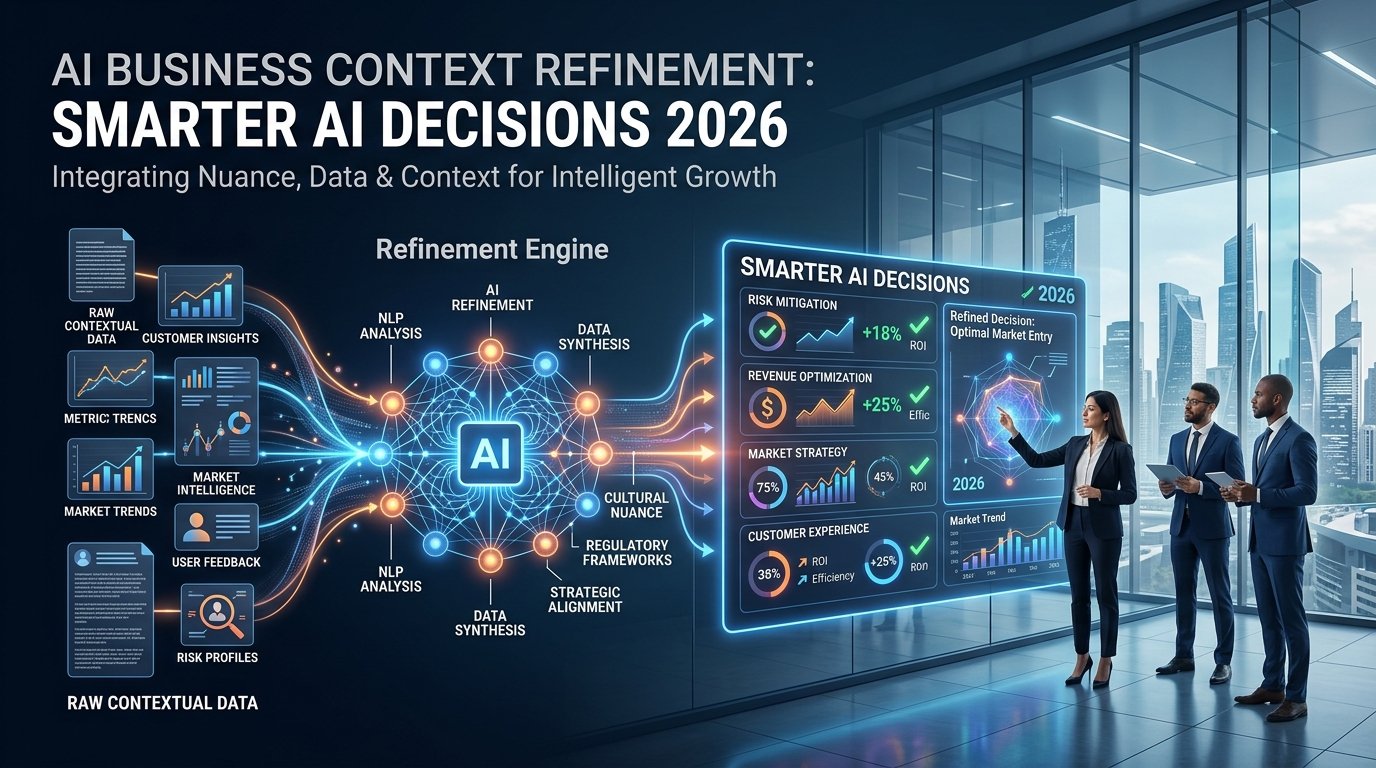
Artificial intelligence is changing the way companies analyse information serve customers, automate workflows and make decisions. I have seen that simply adding an AI tool to a business does not guarantee results. The quality of the information and business rules to the AI can make a major difference.
This is where AI business context refinement becomes important. I believe it is essential.
AI business context refinement is the process of giving an AI system the information, business rules, terminology, workflows, customer data and operational knowledge that AI needs to produce more relevant and reliable results. Of asking AI to make decisions using general knowledge alone businesses provide the context required to understand their specific situation and I think AI makes all the difference.
In 2026 this approach is becoming increasingly important as companies move from AI chatbots toward AI agents and systems that support real business decisions. Context engineering is increasingly viewed as a way to make enterprise data, meaning, policies and workflows usable, by AI systems and I anticipate this will change the industry.
What Is AI Business Context Refinement?
AI business context refinement means keeping the data that an AI system uses fresh and useful so that AI can truly understand a company and what it wants to achieve.
I think a broad AI model can grasp ideas like sales, marketing, finance, customer service or supply chains.. Ai may not know a specific company’s pricing rules, who its customers are the words it uses inside how approvals work what products can do or what goals it has.
Business context is what fills that missing piece.
For example a retailer could give its AI system the following information:
Product information and inventory data
Pricing and discount rules
Customer segments
Return and refund policies
Sales history
Brand guidelines
Customer service procedures
Internal terminology
Business objectives
With this data AI can give suggestions that match the retailer’s day‑to‑day operations more closely.
I believe the aim is not just to hand the AI model data. The aim is to give the data in the right shape at the right moment and, with the right rules and permissions.
Why Business Context Matters for AI Decisions
AI can handle amounts of data fast but business decisions need more than just data crunching.
Those decisions need context.
Imagine a company deciding whether to raise a product price. A basic AI system might suggest a price hike after looking at demand and competitor prices.. An AI system that knows the business context could also think about profit margins, customer loyalty plans, inventory levels, seasonal demand, contracts and brand image.
That extra context can give a more helpful recommendation.
McKinsey research from 2026 on AI and business value shows that many big opportunities, from AI come from making decisions better not just cutting labor costs.
That makes context especially vital when companies use AI to decide on pricing, customer service, forecasts, sales, operations and how to allocate resources.
AI Business Context Refinement vs. Prompt Engineering
AI business context refinement is connected to prompt engineering. The two methods are not identical.
Prompt engineering mainly deals with how to write instructions for an AI model. A crafted prompt can tell AI what job to do what format to use and what limits to keep.
Business context refinement goes beyond that.
Business context refinement focuses on the information environment, around the AI system including:
- Business data
- Policies
- Workflows
- Customer information
- Historical interactions
- Business definitions
- Examples
- Rules and constraints
- Access permissions
- Feedback and corrections
This difference becomes very important when AI systems run all the time or use tools to do tasks. Modern context engineering focuses on giving AI the knowledge and business context refinement instead of relying only on single prompts.
How AI Business Context Refinement Works
A practical AI business context refinement strategy can be divided into several stages.
1. Identify the Business Context
The first step is finding out what the AI really needs to understand.
A company should figure out details, like its products, customers, ways of working, rules, targets, special words and how choices are made.
Not all company information has to be shared with every AI task. The information should match the job that is being done.
2. Organize and Structure Business Data
Business information is often scattered across CRM platforms, documents, spreadsheets, knowledge bases, emails, databases, and collaboration tools.
Simply connecting all these sources does not automatically create useful AI context.
Businesses need to organize information so AI systems can retrieve and interpret the correct information when required.
This is one reason context engineering is increasingly discussed alongside enterprise data management and semantic layers. The objective is not just to expose data but to make its meaning understandable and usable.
3. Add Business Rules and Constraints
AI recommendations should reflect the rules under which a company operates.
For example, an AI sales assistant might need to understand:
- Minimum discount limits
- Customer eligibility requirements
- Approval thresholds
- Contract restrictions
- Regional policies
- Compliance requirements
These rules help prevent AI from making recommendations that look reasonable but conflict with actual business operations.
4. Test AI Outputs
Businesses should test AI using realistic scenarios rather than relying on simple demonstrations.
Teams can evaluate whether the system:
- Uses the correct information
- Understands business terminology
- Follows company policies
- Handles exceptions correctly
- Provides consistent recommendations
- Escalates sensitive decisions when necessary
Testing should continue as business data, policies, products, and customer behavior change.
5. Continuously Refine the Context
Business context is not static.
Business context sees products change. Business context sees pricing change. Business context sees customers change. Business context sees regulations change. Business context sees internal processes change.
If AI continues using information AI recommendations can gradually become less useful.
Continuous refinement is therefore a process of updating information removing outdated material resolving conflicting definitions and learning from errors and feedback.
Benefits of AI Business Context Refinement
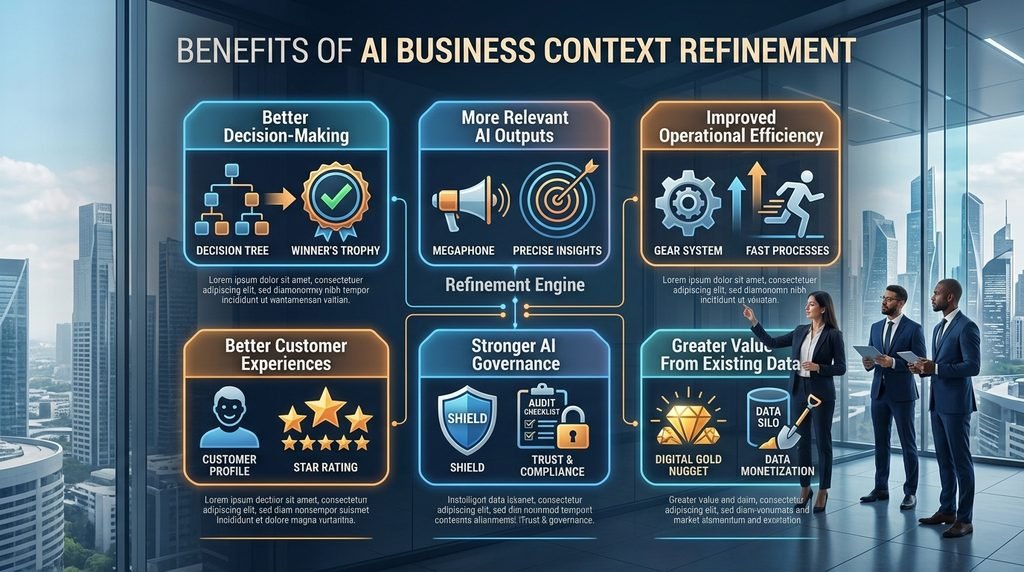
When implemented correctly, AI business context refinement can improve several areas of business performance.
Better Decision-Making
AI can combine business-specific information with analytical capabilities to provide recommendations that are more relevant to a company’s actual situation.
More Relevant AI Outputs
Instead of producing generic responses, AI can communicate using the company’s terminology, policies, products, and objectives.
Improved Operational Efficiency
Employees spend less time searching through documents and systems to gather information before making routine decisions.
Better Customer Experiences
AI systems can use customer history, product information, and company policies to provide more personalized and consistent interactions.
Stronger AI Governance
Clearly defined context, permissions, rules, and escalation processes can help organizations control how AI systems use information and make recommendations.
Greater Value From Existing Data
Companies often already possess valuable information but struggle to use it effectively. Refining business context can help turn fragmented organizational knowledge into usable input for AI systems.
Real-World Applications
AI business context refinement can support many business functions.
Sales
An AI sales assistant can consider customer history, product availability, previous conversations, pricing rules, and account characteristics before recommending the next sales action.
Marketing
Marketing teams can use refined context to help AI understand brand voice, target audiences, product positioning, campaign history, and customer segments.
Customer Support
AI can combine product documentation, customer history, current policies, and escalation rules to provide more accurate support responses.
Finance
Financial AI systems can use company-specific definitions, reporting structures, historical performance, and financial policies when generating analysis.
Operations
AI agents can use workflow rules, inventory information, supplier data, and operational constraints to help identify bottlenecks and recommend actions.
Common Problems to Avoid
AI business context refinement can fail when companies focus only on the AI model and ignore the information surrounding it.
One common problem is outdated context. Old pricing, policies, or product information can lead to incorrect recommendations.
Another problem is conflicting information. If different sources contain different definitions of the same business metric, an AI system may not know which source to trust.
Companies should also avoid giving AI excessive irrelevant information. More context does not automatically mean better context. Effective systems prioritize information based on relevance, accuracy, permissions, and the specific task.
Security is another critical consideration. Sensitive business information should only be available to AI systems and users with appropriate authorization.
AI Business Context Refinement in 2026
The importance of business context is growing as companies move toward AI agents of performing multi-step tasks.
Modern AI agents may interact with databases, CRM systems, enterprise applications, knowledge bases and business workflows. That means the quality of their context can influence not what they say but also what actions they recommend or perform.
Research and industry analysis in 2026 increasingly describe context engineering as a layer for enterprise AI, particularly around governance, retrieval, workflows, memory and business meaning.
As AI agents gain more authority, businesses also need clear controls over what these systems can access and do, including permission expiry and automated safeguards.
For businesses, in the USA, UK and France this creates an opportunity: instead of treating AI as a standalone software tool organizations can build AI systems around their own knowledge, processes and decision frameworks.
Final Thoughts
AI business context refinement is becoming an important part of successful enterprise AI adoption in 2026.
The strongest AI strategy doesn’t always mean picking the most advanced model. It’s really about making sure the AI can access accurate well-organized and properly managed business context.
When companies take the time to refine their AI context they start to move past responses. They begin to deliver useful recommendations improve workflows and speed up business decisions.
As AI agents become a part of daily operations business context will be one of the key differences between experimental projects and reliable systems that create real measurable value, for the business.
FAQs About AI Business Context Refinement
What is AI business context refinement?
AI business context refinement is the process of organizing, updating, and providing business-specific information, rules, workflows, and knowledge to AI systems so they can produce more relevant and reliable outputs.
Why is business context important for AI?
Business context helps AI understand the specific circumstances in which a company operates. It allows AI systems to consider company policies, customer information, business goals, and operational rules instead of relying only on general knowledge.
Is AI business context refinement the same as prompt engineering?
No. Prompt engineering focuses on improving instructions given to an AI model, while business context refinement addresses the broader information, data, rules, workflows, and knowledge available to the AI.
How can businesses improve AI context?
Businesses can start by identifying important knowledge sources, organizing business data, defining rules and permissions, testing AI against realistic scenarios, and continuously updating the information used by AI systems.
Does AI business context refinement help decision-making?
Yes. When AI has relevant and reliable business context, it can produce recommendations that are more closely aligned with company objectives, policies, customers, and operational realities.
4 thoughts on “AI Business Context Refinement: Smarter AI Decisions 2026”