
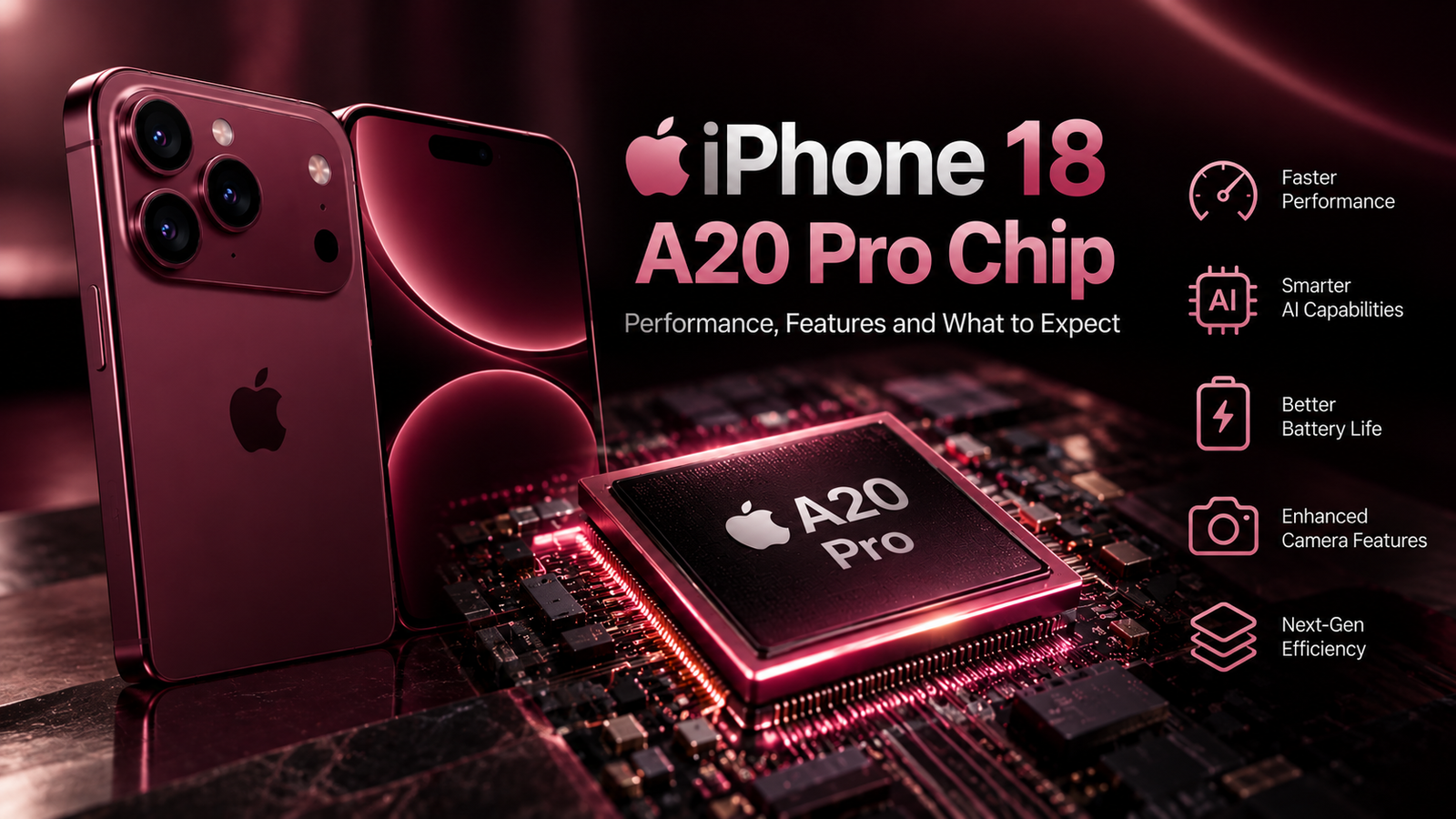
Apple’s new generation of iPhones is expected to provide more than simply a newly designed device. One of the major enhancements could be on the inside of the gadget, with the A20 Pro CPU slated to power the higher-end iPhone 18 variants.
Apple’s A-series CPUs have been a big part of the iPhone experience. It’s all about making each next generation faster, with better energy efficiency, better graphics and more powerful on-device computing. And the A20 Pro will keep that momentum going.
We don’t have all the details from Apple for sure, but early information and industry expectations give us a sense of what the iPhone 18 A20 Pro CPU could bring.
What Is the A20 Pro Chip?
The A20 Pro is said to be Apple’s next-generation high-end smartphone processor. It would probably be exclusive to the Pro variants of the iPhone 18 series.
The CPU should be able to accomplish pretty much all the things the phone does, including apps, gaming, photography, video recording, multitasking and artificial intelligence features.
Apple has been putting more computing power inside its CPUs and not relying so much on cloud-based systems. That makes the CPU particularly critical for emerging AI and computational photography technologies.
If Apple maintains its naming conventions, the A20 Pro might be one of the most powerful mobile chips when the iPhone 18 Pro releases.
A20 Pro Performance
Performance is going to be one of the greatest reasons to consider an iPhone 18 Pro.
The A20 Pro is projected to offer increases in single-core and multi-core performance. This could accelerate regular activities and offer additional processing capacity to more demanding applications.
For normal users the change might not be evident all the time. to a contemporary iPhone, even opening social media apps or going to websites already feels quick. The largest gains should be under larger loads.
For example, users could see speedier video editing, smoother gaming, faster photo processing, and better multitasking.
The processor could also assist the iPhone 18 Pro to retain peak performance for longer periods of time without sucking the battery.
Better AI and On-Device Processing
AI is becoming a big component of the smartphone experience and Apple is likely to continue to grow its AI capabilities.
The A20 Pro may have enhancements to the Neural Engine or other components that handle machine learning workloads. This would enable the iPhone to do more AI-related tasks on the device itself.
Processing on the device itself has many benefits. It can eliminate the need to offload some jobs to remote servers, improve response times, and even provide better privacy.
A speedier CPU will help with things like photo editing, text processing, voice recognition, personalised suggestions and other Apple Intelligence services.
Apple’s focus on on-device intelligence is also expected to play an important role in the wider iPhone 18 experience. You can learn more about the expected iPhone 18 AI features and other upcoming capabilities in our detailed coverage.
This is one area where the A20 Pro could have a more visible impact than usual benchmark gains.
A20 Pro and Battery Efficiency
More performance isn’t always better for battery life.
Apple has always been eager to improve the efficiency of its CPUs and the A20 Pro is likely to be no exception. A more efficient processor can do the same amount of work with less power, perhaps helping the iPhone last longer between charges.
Battery life depends on many elements like display, modem, software, battery capacity, and your use of the phone. But CPU efficiency is still crucial.
If Apple can increase both performance and power efficiency, iPhone 18 Pro customers could enjoy a handy mix of speed and endurance.
New Manufacturing Technology
One of the most interesting parts of the A20 Pro could be the manufacturing process behind it.
Apple has been moving toward smaller and more advanced chip manufacturing technologies to improve efficiency and transistor density. The A20 generation is widely expected to benefit from a newer manufacturing process compared with previous A-series chips.
A more advanced process can allow manufacturers to fit more transistors into a similar amount of space. This can potentially improve performance while reducing energy consumption.
However, the exact manufacturing specifications and their real-world benefits will need to be confirmed when Apple officially announces the chip.
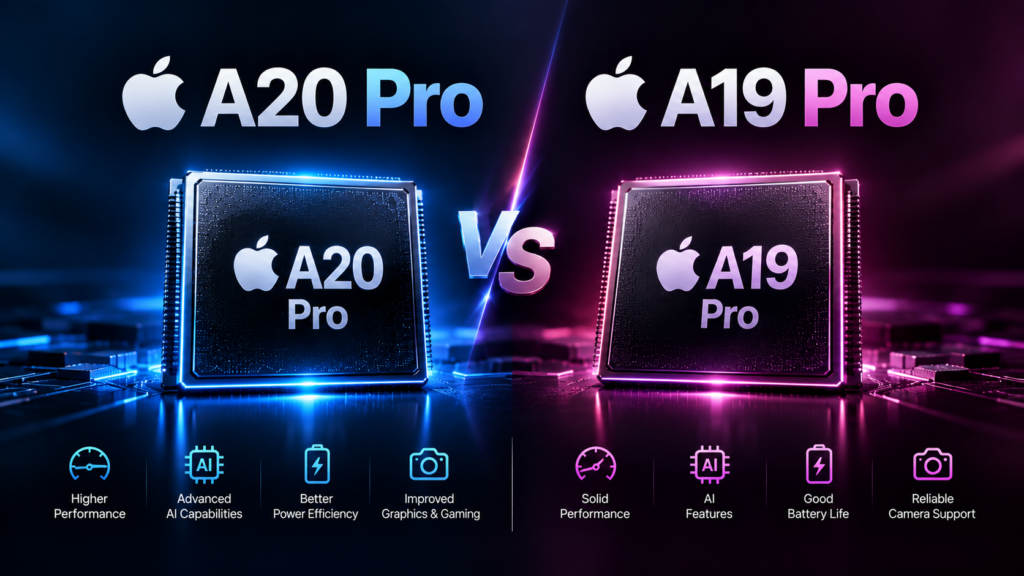
20 Pro vs A19 Pro
The A20 Pro is expected to improve on the previous-generation A19 Pro, but the exact performance difference is not yet confirmed.
| Feature | A19 Pro | A20 Pro |
|---|---|---|
| Generation | Previous generation | Next generation |
| Performance | High-end | Expected to be faster |
| AI processing | Advanced | Expected to improve |
| Power efficiency | Strong | Expected to improve |
| Gaming | Excellent | Expected to offer better graphics performance |
| Camera processing | Advanced | Expected to be faster |
| Manufacturing | Previous process | Expected to use newer technology |
The biggest improvement may not be raw speed. Better efficiency, AI processing, and sustained performance could be more important for everyday users.
If you are also comparing the overall upgrade between generations, our iPhone 18 vs iPhone 17 comparison looks at the expected differences beyond the processor, including performance and other key features.
A20 Pro for Gaming
Mobile gaming is becoming more and more demanding Modern titles require powerful CPUs and GPUs .
The iPhone 18 Pro could power up a more robust graphics engine for premium gaming on the A20 Pro. If you can process graphics faster, you should expect greater frame rates, better visual effects, and more reliable performance.
Apple has also been attempting to elevate the iPhone to the level of console gaming. A more powerful GPU would help with that goal.
For a casual gamer it might not matter that much. But for those who play graphics-heavy games regularly, the A20 Pro could be a big increase.
Camera and Video Improvements
The processor is also a big player in smartphone photography.
Modern iPhones don’t only take what the camera sensor sees, they process photographs with computational photography . The CPU helps with HDR, noise reduction, image sharpening, portrait effects, and other calculations.
A more powerful A20 Pro could consequently improve the iPhone 18 Pro’s photo and video processing.
More computing power would also help with recording video. Recording at a higher quality, with better stabilisation, real-time effects, editing faster all takes a lot of processing power.
That implies the A20 Pro upgrade could be handy even if the physical camera hardware doesn’t change substantially.
Which iPhone Models Could Get the A20 Pro?
Apple traditionally separates its standard and Pro iPhone models by giving the Pro versions more powerful chips or additional features.
Based on that approach, the A20 Pro chip would most likely be associated with the higher-end iPhone 18 Pro models.
Apple is also expected to expand its product lineup with new form factors. For readers interested in Apple’s foldable plans, our coverage of the iPhone Fold explores what is expected from the company’s first foldable iPhone.
The exact lineup and chip distribution will depend on Apple’s final product strategy. Until the company officially confirms the specifications, these details should be treated as expectations rather than guaranteed features.
Is the A20 Pro a Big Upgrade?
For someone using an older iPhone, an iPhone 18 Pro with an A20 Pro could represent a significant overall upgrade.
However, people already using a recent Pro iPhone may not notice a huge difference in basic everyday tasks. Modern Apple chips are already extremely fast.
The real advantages could appear in areas such as AI, gaming, video editing, camera processing, and battery efficiency.
For professionals and power users, those improvements could make the upgrade more meaningful.
Final Thoughts
The iPhone 18 A20 Pro chip could be one of the biggest advancements coming to Apple’s next-gen Pro iPhones. Apple is probably going to enhance multiple areas at the same time, not just focus on greater benchmark statistics.
It’s a big element of the iPhone 18 Pro experience, and the A20 Pro might offer faster performance, greater AI processing, improved efficiency, stronger graphics and better camera capabilities.
For a closer look at how Apple’s next-generation chip could affect the foldable lineup, check out our detailed analysis of iPhone Duo performance and the A20 Pro chip.
There are still many technical details to be determined at this moment. Final specs and performance details will be shared by Apple with the formal announcement of the iPhone 18 series.
Until then, the A20 Pro is an interesting piece of what may be Apple’s next big move in smartphone performance.
One thought on “iPhone 18 A20 Pro Chip: Performance, Features and What to Expect”