

Think about a normal Monday morning. Your inbox is already sorted. Last week’s invoices are already checked. A customer wrote to you at 2 a.m., and got a helpful reply. Nobody on your team woke up to do it. This is what AI and automation can do for you when you set them up well. You don’t need a big company for this. Freelancers and small shops use it too.
But there is a lot of hype around this topic. Some people say machines will do all the work. Others say machines will take every job. Both ideas are too extreme. In this article, we will explain what the technology is, what trusted research says, where it helps, where it fails, and how you can start in a safe and simple way.
What Is AI and Automation?

People often mix up these two ideas. Let’s make them clear.
Automation follows rules. For example, a customer fills in a form, and the system sends a thank-you email. An invoice arrives, and the system copies its details into a spreadsheet. A person sets the rules one time. After that, the software repeats the task all day and never gets tired.
AI is different. It learns from examples. It can read an email, look at a photo, guess what may happen next, or write a first draft. This makes AI useful for tasks that don’t follow simple rules. For example, it can understand what an unhappy customer really wants.
When you use both together, each one fixes the other’s weakness. Automation gives you speed. AI gives you flexibility. Here is an example. A support message comes in. AI reads it and decides if it is about billing, delivery, or a complaint. Then automation sends it to the right person, along with the customer’s history.
Why AI and Automation Matter Today
This is no longer only a topic for tech companies. Many types of businesses now use it.
McKinsey published its State of AI in 2025 survey in November 2025. It found that 88 percent of people surveyed say their organizations use AI regularly in at least one business function. One year earlier, the number was 78 percent. The survey included 1,993 people from 105 countries.
But there is a catch. Most of these organizations are still testing AI or running small pilots. Only about one-third say they are using AI across the whole company. So many businesses have started, but few have changed the way they work. For small teams that move fast, this is a good chance to catch up.
The survey also asked about AI agents. These are systems that can plan and finish several steps by themselves. About 62 percent of people said their organizations are at least trying them. About 23 percent said they are already using one at larger scale in at least one area. These numbers come from what people reported, so they show the direction, not an exact count.
You can read the original results on the McKinsey website.
Where AI and Automation Are Used Every Day
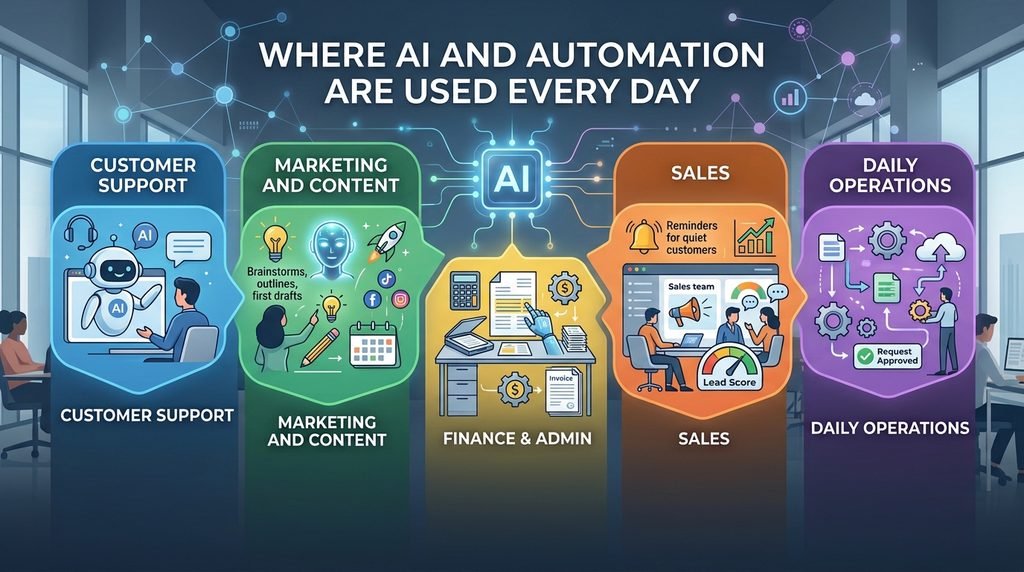
The best way to understand this technology is to see where people already use it.
Customer support. Chat assistants can answer common questions at any time of day. If a problem is hard, automation sends it to a person with the full chat history. The customer does not need to explain everything again.
Marketing and content. AI can help with research, outlines, email subject lines, and first drafts. Automation can schedule posts and send follow-up emails. The key word is help. A person should always check the facts and add real experience before publishing.
Finance and admin. Software can collect invoices, match them with orders, and mark anything strange. AI can read scanned papers and pick out the important details. This means fewer mistakes and less stress at the end of the month.
Sales. Tools can rate leads, update records, and remind your team when a customer goes quiet. They don’t replace a good conversation. They just help you remember to have one.
Daily operations. Teams use automatic workflows to move data between apps, approve simple requests, and send alerts. When the boring work runs by itself, people have more time to improve how the team works.
Want simple ideas and tool guides for your own work? Visit the WebAIAutomation homepage to learn more.
The Benefits of AI and Automation
Let’s be honest about what this technology does well. The real benefits are already good, so we don’t need to exaggerate.
The biggest benefit is time. Data entry, sorting, and simple replies can run in the background. Your team gets time back for work that needs real thinking. A good workflow also does a task the same way every time. It does not get careless at the end of a long day.
Speed is another benefit. Customers and coworkers get answers faster, and this often builds trust. AI can also read much more information than a person can, and find patterns that people may miss. With all this help, a small team can do more work without hiring many new people.
Notice what is not in this list: guaranteed profit, instant results, or no effort. Good results come from choosing the right problem and building the solution with care.
The Risks of AI and Automation
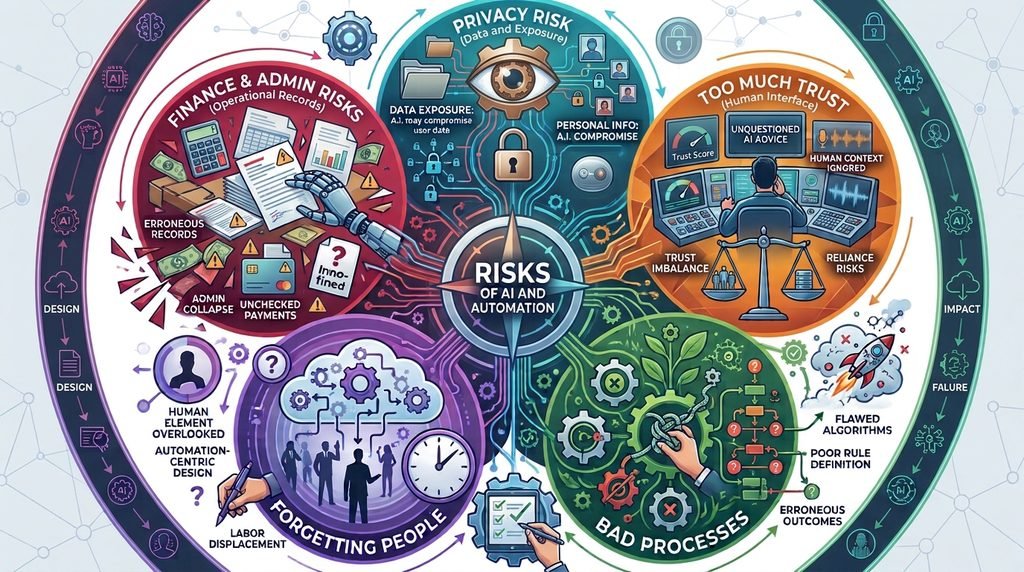
An article that only shows the good side is not trustworthy. So let’s talk about the risks too.
The same McKinsey survey found that 51 percent of people had seen at least one bad result from using AI. The most common problem was wrong or inaccurate answers, reported by 30 percent. Next came cybersecurity worries at 10 percent. Problems with rules and regulations came after that at 8 percent.
Many everyday users see the same thing. AI can sound very sure of itself and still be wrong. So if the topic is money, health, law, or anything you will publish, a person must check the work first.
Here are some other common problems:
- Privacy. Don’t put private customer or company information into a tool unless you know how the tool saves and uses it.
- Bad processes. If you automate a messy process, you only get the same mess, faster. Fix the process first.
- Too much trust. If nobody on your team understands how a workflow works, nobody can fix it when it stops.
- Forgetting people. Your team needs training and a clear reason for the change.
AI and Automation and Your Job

Most people want to know one thing: will AI take my job?
The World Economic Forum has one of the most quoted studies on this. Its Future of Jobs Report 2025 asked more than 1,000 of the world’s biggest employers. They cover 22 industry groups and more than 14 million workers. The report expects about 170 million new jobs to be created by 2030. It also expects about 92 million jobs to disappear. That leaves a net gain of about 78 million jobs. The report says about 22 percent of today’s formal jobs will be affected by these changes.
These numbers are predictions from employer surveys. They are not promises. They also hide real problems for workers whose jobs change. But they show that the story is not just “jobs will vanish.” It is more like “jobs will change, and skills will matter more.”
The report expects fast growth in technology jobs, such as AI, machine learning, and data analysis. It also expects growth in care, health, and education jobs. It says many key skills will change by 2030. This is why learning new things regularly is so important.
You can read more in the World Economic Forum’s report summary.
The lesson is simple. People who learn to work with AI and automation will usually be in a better position than people who ignore it. Skills that machines are weak at will matter more, such as kindness, negotiation, creativity, and good judgment.
How to Start with AI and Automation This Week
You don’t need a big budget or a technical degree. You only need one small problem and some patience.
- Write down your repeated tasks. For one week, note every task you do more than twice. Look for tasks that are boring, follow clear rules, and take a long time.
- Pick one safe task. Good first tasks are sorting emails, saving form answers, or summarizing meeting notes. Don’t start with your most private work.
- Write the steps. Put the current steps on paper. If you can’t explain the process clearly, you are not ready to automate it.
- Choose an easy tool. Many no-code tools let you connect apps without programming. Try a free plan, test with fake data, and read the privacy policy.
- Keep a person in charge. Check the results, especially at the start. Add an approval step where a mistake would cost a lot.
- Measure and improve. Track the time you save, the mistakes you avoid, and what customers say. Keep what works. Fix what doesn’t. Then try the next task.
For more easy workflow ideas, read the WebAIAutomation blog.
Common Myths About AI and Automation
“It is only for big companies.” Many people and businesses use it now, and many tools are made for small teams and individuals.
“It works perfectly right away.” It does not. McKinsey’s data shows that most organizations are still in the testing stage. Real value takes practice and better ways of working.
“It means we don’t need people.” The best results usually come when people and software each do the job they are best at.
“You must be a programmer.” Many modern tools are made for people with no coding skills. Basic computer skills and clear thinking help a lot, but coding is not required.
Final Thoughts on AI and Automation
The real story of AI and automation is not humans against machines. It is about people who learn to use strong tools in a smart way. The research gives reasons to be hopeful, because more businesses are using AI and new kinds of jobs are expected. It is also a warning to be careful, because wrong answers, privacy problems, and poor planning can cause real trouble.
If you remember only one thing, remember this: start small, check important work twice, and keep people at the center. Choose one repeated task this week, automate it with care, and see what you learn. Small wins add up faster than you think.
Want more practical guides, tool comparisons, and workflow ideas? Visit WebAIAutomation.com and keep learning, one step at a time.
One thought on “How AI and Automation Are Changing the Way We Work in 2026”