
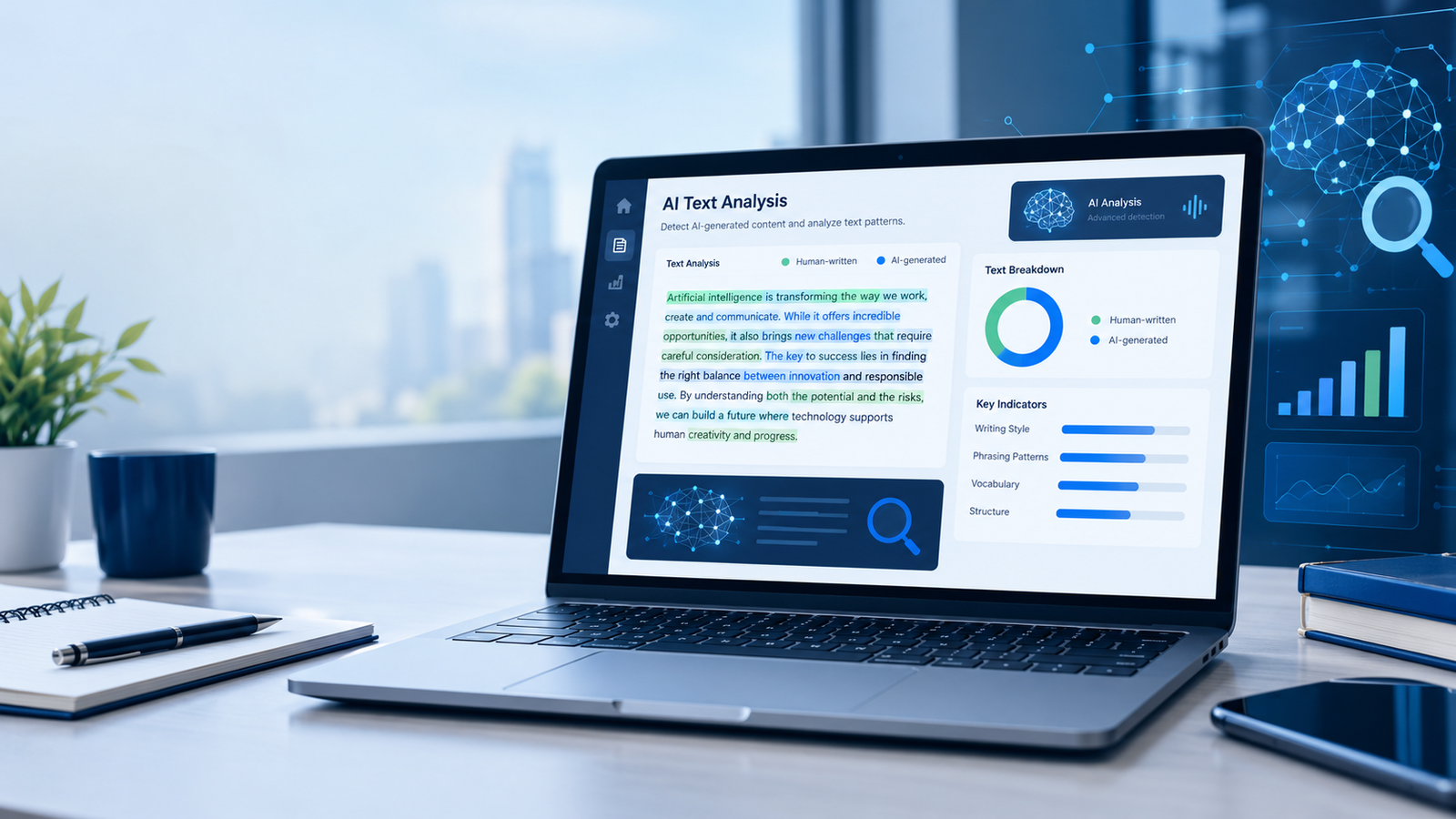
AI technologies have revolutionized the way blog posts, essays, reports, marketing, and other types of content are written. AI models like ChatGPT, Gemini, and Claude can produce written material in mere seconds; however, one must have a means of analyzing the source from which such text could be produced. The AI detection tool allows for estimating whether a given piece of writing follows AI writing patterns.
It is not enough to consider accuracy when deciding upon a tool to use for the task. There are detectors oriented specifically at academic writing, while there are others aimed at publishers, SEO specialists, and content creators.
This article provides the comparison of five of the most popular AI detection tools, along with their key features and instructions on the use of the results obtained through the process of detection.
The list provided hereafter is bound to prove useful for everyone managing their blog, checking freelance applications, or writing content with the help of AI.
What Is an AI Detection Tool?
An AI detection tool is a program that studies the text and makes the estimate as to whether it has been written by a person or an AI model. Such programs employ statistical and machine learning approaches to categorize texts. Different services provide different outputs, such as scoring, highlighting of individual sentences, or generating a detailed report.
For instance, a copyeditor can analyze a guest post prior to publishing in order to find suspicious parts. A teacher can employ the service as a part of an integrity check process. An SEO specialist can analyze the text before passing it on to the client.
The AI detector cannot give a complete history of how the text was written. The software determines the likelihood of the text being written by an AI.
For more practical information about AI-powered workflows, explore our guide to AI automation for small businesses.
Top 5 AI Detection Tools to Try
The following tools serve different audiences and workflows. Instead of treating one detector as universally superior, compare their features and select the option that meets your needs.
1. GPTZero — Best for Educational and Writing Reviews
GPTZero is a well-known AI detection platform designed primarily for educators, students, and professionals who review written content. It analyzes text for patterns associated with AI-generated writing and can highlight sections that warrant further examination.
Key features:
- AI-generated text detection.
- Sentence-level analysis and text highlighting.
- Writing review features for educational environments.
- Options for checking longer documents, depending on the plan.
Who should use it?
Teachers, students, editors, and writers can use GPTZero to review text and identify sections that need additional attention. Its sentence-level feedback can help users investigate a document rather than relying only on an overall score.
Main limitation: GPTZero cannot establish authorship with certainty. Human-written text may receive an AI classification, and edited AI content may escape detection.
Visit the official GPTZero website to explore its current features and access options.
2. Originality.ai — Best for SEO Professionals and Publishers
Originality.ai is concerned with content validation and editorial process. It targets publishers, SEO firms, website owners, and content managers who evaluate articles before publishing.
The tool integrates the AI detection technology with some more content-checking tools such as plagiarism detection. In addition, depending on the chosen subscription plan and the available tools, some features for readability or fact-checking can be used.
Key features:
- AI-generated content detection.
- Plagiarism checking.
- Content review for editorial teams.
- Reporting features that support publishing workflows.
- Tools designed for website owners and professional content operations.
Who should use it?
SEO professionals can consider Originality.ai when they manage multiple writers, review guest posts, or maintain editorial standards across several websites. For example, an editor can use it as one screening step before checking an article’s sources, originality, usefulness, and search intent.
AI score is no substitute for a professional editorial assessment. The search performance is determined by quality, relevancy, accuracy, and user value of the content—this cannot be achieved with the use of AI writing detection alone.
In case you deal with automatic content publication processes, you may want to check our article about AI agents for small businesses.
Main limitation: Originality.ai is a commercial product and certain features are dependent on the current subscription plans. Please check the pricing and conditions of use before subscribing.
3. Copyleaks — Best for Multilingual and Organizational Workflows
Copyleaks provides not only plagiarism detection but also AI-based content detection and other types of content integrity services. The company’s solutions cover a variety of organizational needs, such as education, publishing, and business content verification.
Key features:
- AI-generated text analysis.
- Plagiarism detection options.
- Support for multiple languages, subject to product limitations.
- Integrations and API options for supported workflows.
- Solutions for organizations that need repeatable content checks.
Who should use it?
The Copyleaks software might work for education organizations, bigger editorial teams, and enterprises that deal with content in various languages. The organization might explore the integration opportunities for the software if it wants to tie the content checking with the existing process or system.
For instance, an organization that produces articles for different markets might employ a detection tool to complement its editorial process. However, editors need to check translation, citations, facts, and author’s contribution to the paper.
Limitations: The performance of the detection will differ depending on the language, kind of the text, and how a person edits and integrates AI-generated content with human content.
Visit the Copyleaks AI detector for current product information.
4. Winston AI — Best for Document and Content Screening
Winston AI offers an AI content detection tool that can be used by those who want to examine any written content. It is aimed at users such as educators, publishers, and content specialists.
Features:
- AI-generated text detection.
- Document and text scanning options.
- Reports that help reviewers examine submitted content.
- Additional content verification features, depending on the plan.
Who should use it?
Winston AI can be evaluated if you often look for articles, essays, or other papers. In case of a publishing house, it can check an article and then analyze the highlighted paragraphs, where there may be generic text, unsubstantiated claims, repetitions, or lack of supporting evidence.
Base your analysis on the findings rather than automatically reject the article.
Main drawback: It is impossible to identify the author of a paper by means of a detection report. Make sure that the latest information about the product covers the supported formats and usage options.
Visit the official Winston AI website to learn more.
5. ZeroGPT — Best for Quick, Accessible Checks
ZeroGPT presents an easy-to-use tool to detect patterns in texts that relate to AI-generated content. Its easy-to-use interface may be attractive to those users who need to do a quick and rough analysis without developing a complicated editorial process.
Main characteristics:
- Text-based AI detection.
- A simple interface for checking submitted content.
- Results intended to help users investigate potentially AI-generated writing.
- Access options that users can review on its website.
Who should use it?
For bloggers, freelance writers, students, and infrequent users, you could try using ZeroGPT for initial screening.
Do not alter good text just because a detector requests you do so. Instead, work on expressing your ideas clearly, giving illustrative examples, sourcing your references, and writing in a natural way.
Main drawback: Initial screening only gives an estimate of authorship, but it doesn’t prove anything. Ensure that you read through the latest terms of service and privacy policy at the provider’s site before uploading any sensitive or unpublished text.
Visit the official ZeroGPT website to try its available features.
AI Detection Tools Compared
| Tool | Best use case | Notable strength |
|---|---|---|
| GPTZero | Education and writing reviews | Sentence-level feedback |
| Originality.ai | SEO teams and publishers | AI detection and plagiarism checking |
| Copyleaks | Organizations and multilingual workflows | Language support and integration options |
| Winston AI | Document and content screening | Content review reports |
| ZeroGPT | Quick initial checks | Simple interface |
This comparison highlights general use cases, not independently verified accuracy rankings. Features and access limits can change, so check each provider’s official website before making a purchase.
How to Choose the Right AI Detection Tool
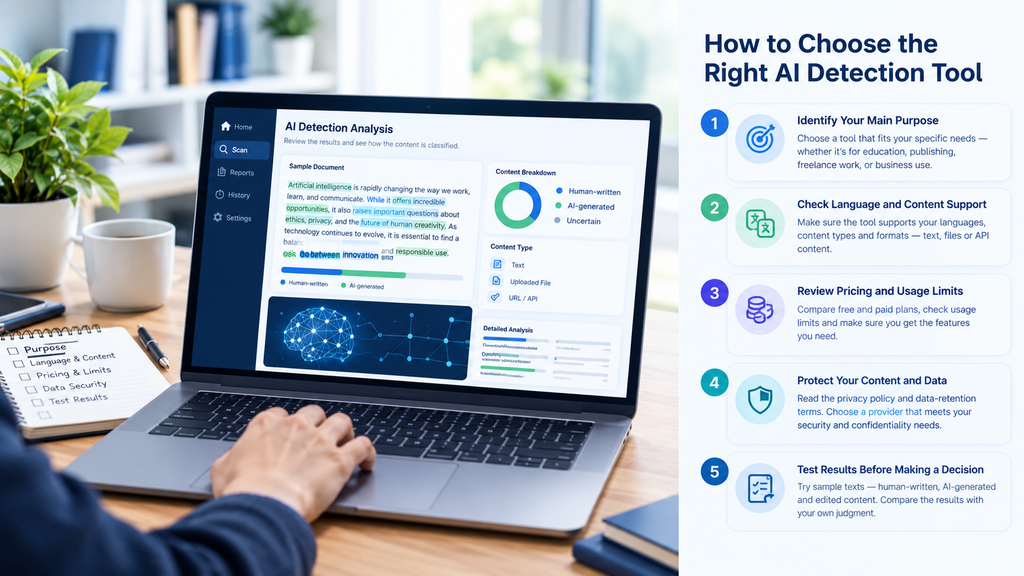
The best AI detection tool depends on what you want to accomplish. Consider these factors before selecting one.
1. Identify Your Main Purpose
Start by defining your use case. Educators would consider functionality related to review of educational material; publishers would consider plagiarism detection and team collaboration; freelancers would consider easy usability for rare usage.
Choose software that actually addresses your problem instead of paying for extra functionalities.
2. Check Language and Content Support
All detectors do not work uniformly for all languages and styles of writing. Should you have multilingual articles, ensure that you carry out testing using samples before applying the results generated.
One must also think about whether they will be testing copied text, uploaded files, or API-based content.
3. Review Pricing and Usage Limits
Some software may provide you with a limited number of uses while other software may require you to pay extra to get full reports, higher use levels, or team options.
It should be noted that not all free detectors are equipped with the same capabilities as the paid ones.
4. Protect Your Content and Data
Before uploading client work, unpublished articles, student assignments, or business documents, review the provider’s privacy policy and data-retention terms.
If you manage confidential material, choose a service whose data practices meet your organization’s requirements.
5. Test Results Before Making a Decision
Use a number of sample texts that are representative, including hand-written text, AI-produced text, and collaborative or revised text. Compare the results against their writing history.
While this approach cannot provide universal accuracy, it is helpful in learning how the tool functions for you specifically.
Are AI Detection Tools Always Accurate?
No. This is because there is no guarantee that an AI detector will not give a false positive result, i.e., classify human-written text as AI-generated. Additionally, a false negative result is possible as well – the detector will fail to recognize AI-generated text.
Style of writing, size of the text, level of language proficiency, editing, and even a model that an AI detector is based on may influence the result.
OpenAI used to have an AI text classifier, but it was discontinued back in July 2023 due to its poor accuracy. In addition, according to its documentation, AI detectors may sometimes classify human-written text inaccurately. Read OpenAI’s explanation of AI detection limitations.
This is why you should never rely only on the detector’s score when accusing someone of misconduct or rejecting their work. Consider drafts, document’s history, quality of sources used, and writer’s explanation and other evidence.
How SEO Professionals Should Use AI Detection Tools
SEO experts can integrate detection tools within a more comprehensive content quality workflow. But the aim should be to create helpful and credible content and not to get a low AI detection rate.
Use this workflow:
- Review search intent: Make sure the article answers the questions readers actually have.
- Verify facts: Check statistics, product claims, quotations, and external sources.
- Add original value: Include relevant examples, practical experience, comparisons, or expert insights.
- Improve readability: Remove unnecessary repetition, vague claims, and awkward transitions.
- Check originality: Use appropriate plagiarism checks and verify that sources receive proper attribution.
- Review the detector result: Treat flagged sections as prompts for investigation, not automatic evidence of AI authorship.
- Complete the editorial review: Confirm that the final article is accurate, useful, well structured, and ready for publication.
You can make this workflow more effective using our guide to choosing the right automation tools, especially if your team plans to integrate content creation with other business processes.
The guidelines from Google concentrate on the quality and the intention behind the content but do not mandate passing of the AI detector for the publishers. Review Google Search’s guidance on AI-generated content before developing your publishing policy.
Frequently Asked Questions
What is the best AI detection tool?
The best option depends on your needs. GPTZero suits educational and writing reviews, Originality.ai targets publishers and SEO teams, Copyleaks supports organizational workflows, Winston AI offers content screening, and ZeroGPT provides a simple option for quick checks.
Are free AI detection tools reliable?
Free tools can help with preliminary reviews, but no detector guarantees correct results. Test the tool with relevant samples and verify important findings independently.
Can an AI detection tool detect ChatGPT content?
Many detectors attempt to identify patterns associated with ChatGPT and other language models. However, results vary, and a detector may miss AI-generated text or incorrectly flag human writing.
Does Google require content to pass an AI detector?
Google does not require website owners to pass an AI detection test. Publishers should focus on helpful, reliable, people-first content that follows Google’s spam policies and quality guidance.
Should writers use an AI detector before publishing?
Writers can use one as an optional review step, especially when clients request it. They should prioritize factual accuracy, originality, clarity, and editorial standards instead of chasing a particular detection score.
Final Verdict
The following AI detector tool can be used to research the history behind the creation of any written material. The GPTZero, Originality.ai, Copyleaks, Winston AI, and ZeroGPT are some examples of the best AI detectors, each having their own unique features; therefore, your choice will depend on your personal needs.
For SEO agencies and publishers, Originality.ai should be considered for its two main capabilities: AI detection and plagiarism checker. The GPTZero can serve well as a writing review tool, and Copyleaks can work for those organizations who need multilingual services.
First and foremost, it is important not to use the result of the AI detection as the only proof of authorship of the text. The detector tool should be combined with other approaches to keep the quality of your content.