
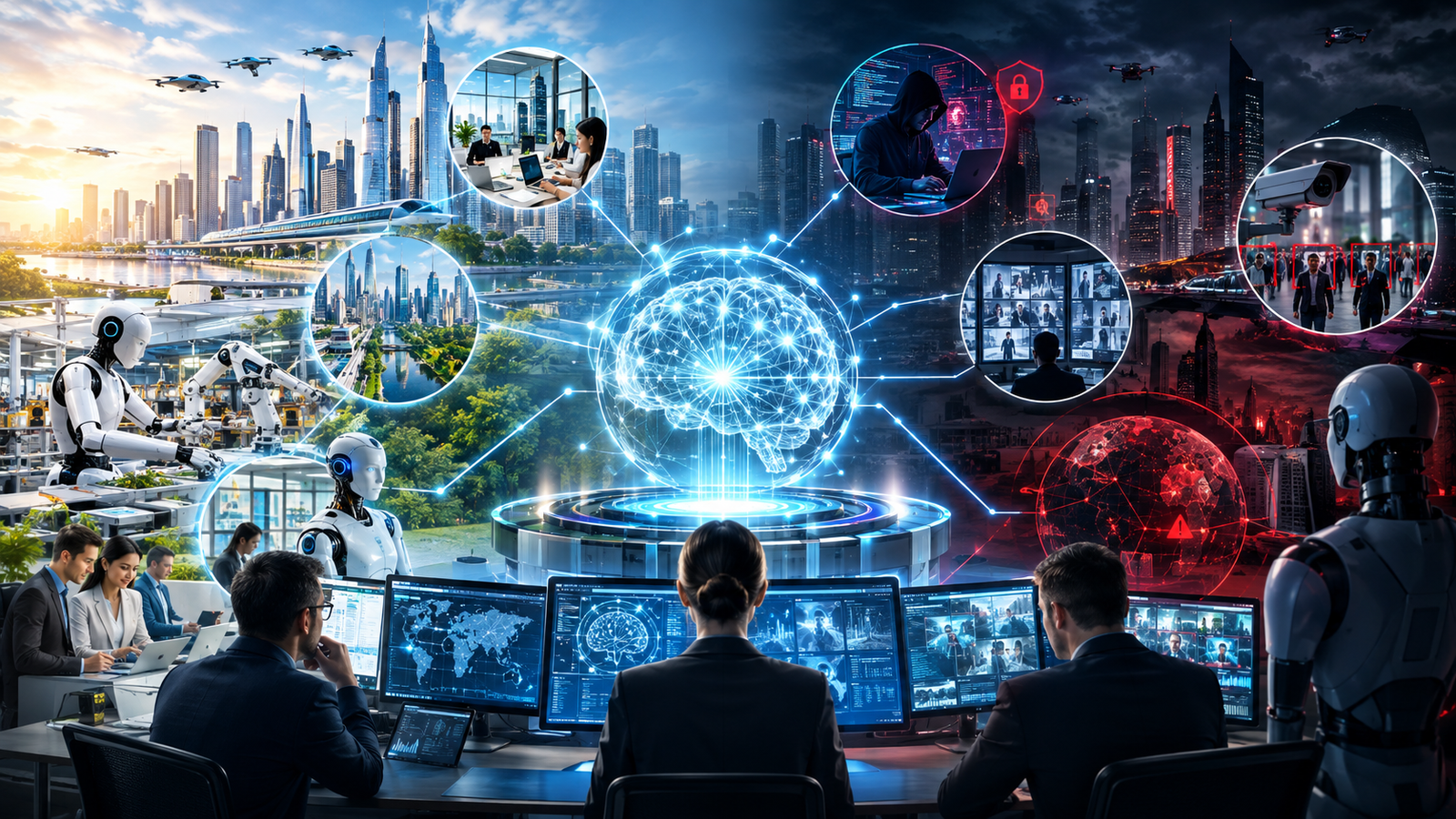
I think Artificial intelligence has moved from the world of science fiction into our life. AI can write articles read data create pictures run tasks automatically help programmers, answer customers and guide businesses. As these powers grow one question keeps drawing interest: will AI take over the world?
The question sounds dramatic. It brings real concerns about machines doing work how humans keep control, safety, jobs, privacy, internet security and how people will relate to intelligent machines in the future.
The short answer is that nobody can predict a future where AI rules the world. AI systems today can do complex jobs but that is not the same, as having their own goals feeling like humans or ruling society.
At the time ignoring AI risks would also be wrong. The U.S. National Institute of Standards and Technology or NIST keeps an AI Risk Management Framework to help companies spot and handle risks that come with AI.
What Does AI Taking Over the World Actually Mean?
Before asking whether AI will take over the world it is important to define what “take over” means.
Some people imagine machines controlling governments, economies, infrastructure and human behavior. Others use the phrase to describe something more practical: AI becoming so widespread that it performs a large portion of the work currently done by people.
These are different scenarios.
AI is already changing how people work. Generative AI can produce text, images, software code, summaries and other outputs. AI agents are also becoming capable of completing -step tasks with less direct human intervention.
ESADE’s 2026 discussion of AI agents describes this shift from AI answering questions, toward systems that can manage workflows make decisions and execute tasks automatically.
That development makes human oversight increasingly important. It does not automatically mean machines are preparing to control humanity.
Will AI Take Over the World in 2026?
So will AI take over the world in 2026?
There is no proof that artificial intelligence will take control of the planet in 2026. Current AI systems still rely heavily on human-made systems. They need computers, data, power, networks and people to decide how and where to use them.
The real concern is not a robot uprising. The real concern is how fast AI is being added to life.
Companies now use AI in areas—like advertising, helping customers writing code finding new information spotting fraud managing supply chains analyzing data and running machines. Governments and other groups are also testing AI for tasks.
This means the path AI takes depends a lot, on choices made by humans now.
The NIST AI Risk Management Framework stresses that AI should be safe, secure, resilient, accountable transparent explainable, private and fair. These traits help make AI trustworthy and responsible.
Can AI Take Over the World Without Human Control?
The question of will AI take over the world becomes more complicated when AI systems are given freedom to act on their own.
Traditional software usually does things that are already planned out. Powerful AI systems can understand what needs to be done choose the right steps use tools and finish a series of tasks.
This does not mean they start to have their desires or goals.
An AI system works inside the environment that is set up for it. Programmers decide how it is built what it can access, what it is allowed to do what tools it can use and where it is placed. Companies decide where the AI is used and how power it has.
Too much freedom can lead to real problems.
For instance a company could let an AI system access databases, money systems, customer information or important software without enough rules. If the system makes a choice the results could be serious.
As AI systems become more capable of performing tasks with less direct human intervention, questions about autonomy and control become increasingly important. For a broader discussion of whether artificial intelligence could eventually take over the world, see this analysis of AI’s potential impact on humanity.
That is why AI control and management are important.
Why AI Could Be Beneficial for Humanity
Discussions about will ai take over the world often focus exclusively on negative scenarios. However, AI can also provide substantial benefits.
1. Automation of Repetitive Work
AI can automate repetitive administrative and digital tasks, allowing employees to spend more time on creative, strategic, and interpersonal activities.
2. Faster Access to Information
AI systems can summarize large amounts of information and help users identify patterns that might otherwise take humans considerable time to discover.
3. Scientific and Medical Research
AI can assist researchers in analyzing complex datasets, identifying patterns, and exploring potential solutions.
4. Improved Business Productivity
Companies can use AI to automate customer support, content workflows, data analysis, software development, and internal processes.
5. Accessibility
AI-powered tools can assist people with translation, speech recognition, summarization, image understanding, and other tasks that make digital information easier to access.
NIST notes that AI has significant potential across areas including commerce, health, transportation, cybersecurity, and environmental applications, while also recognizing that AI can create risks requiring active management.
The Real Risks of an Artificial Intelligence Takeover
If will ai take over the world is interpreted as “could AI create serious problems for humanity?”, the discussion becomes much more realistic.
There are several risks worth watching.
Job Displacement and Economic Disruption
AI automation could change the tasks that people do in jobs. Some jobs might get smaller in size. Become different as machines take over certain duties. At the time new jobs could appear in areas like building AI systems putting them into use managing them keeping them safe, from cyber threats and making sure they are used responsibly.
The key question is not just whether AI will take away jobs. It’s more about how fast companies bring in automation and whether workers have chances to learn new skills and adjust to these changes.
Misinformation and Manipulation
Generative AI can produce convincing text, images, audio, and video. This creates challenges around misinformation, impersonation, fraud, and public trust.
Privacy Concerns
AI systems can process enormous quantities of information. Poor data practices can create privacy risks, particularly when sensitive information is collected, stored, or used without appropriate safeguards.
Cybersecurity Risks
AI can potentially strengthen cybersecurity, but it can also introduce new vulnerabilities and help malicious actors automate certain activities. NIST identifies security and resilience as important components of trustworthy AI.
Biased or Unfair Decisions
AI systems can produce harmful outcomes when their data, design, implementation, or use introduces bias. This is one reason organizations need testing, monitoring, and governance rather than assuming an AI system is automatically objective.
Can Artificial Intelligence Control the World?
Could artificial intelligence eventually take over the world?
There is a difference between having an effect and actually being in charge.
Artificial intelligence can have an effect on choices when people depend on what it suggests. Search engines, tools that suggest things to watch or read, computer programs that help with money software used at work and helpers that use intelligence can all shape what people do without really running society.
The more power given to intelligence systems the more important it is to have protection measures.
For instance an artificial intelligence program that suggests a headline, for a marketing campaign has limited effects. An artificial intelligence system that is allowed to approve loans change structures carry out money moves or make choices that affect peoples rights needs much stronger rules.
This is why rules and control need to grow at the time as the abilities of artificial intelligence.
What Are the Dangers of Artificial Intelligence?
The dangers of intelligence are not only about a pretend superintelligent machine.
Some risks already exist.
AI can produce information. AI can repeat biases that are built into its training data. AI can reveal details if it is badly built. AI can create false news. AI can also make mistakes in automation on a level that would be hard for a single person to duplicate.
NISTs framework treats AI risks as short‑term or long‑term, local or systemwide and high or low impact. NIST recommends looking at risks during the AI lifecycle not only after the system is launched.
For businesses this means AI adoption must involve testing, monitoring, access controls, human supervision and clear responsibility.
AI and the Future of Humanity
I think the future of AI is unlikely to be determined by technology
I believe human decisions will influence how AI is developed, regulated, deployed and integrated into society.
I wonder the question will ai take over the world therefore has another dimension: how much authority will humans choose to give AI?
When organizations deploy AI responsibly automation could improve productivity while humans retain meaningful oversight.
When organizations deploy systems carelessly the consequences could include privacy failures, security incidents, discriminatory outcomes, misinformation or controlled automated decisions.
The challenge is therefore not simply stopping AI. AI is learning how to use powerful systems responsibly.
How Can We Prevent an AI Takeover?
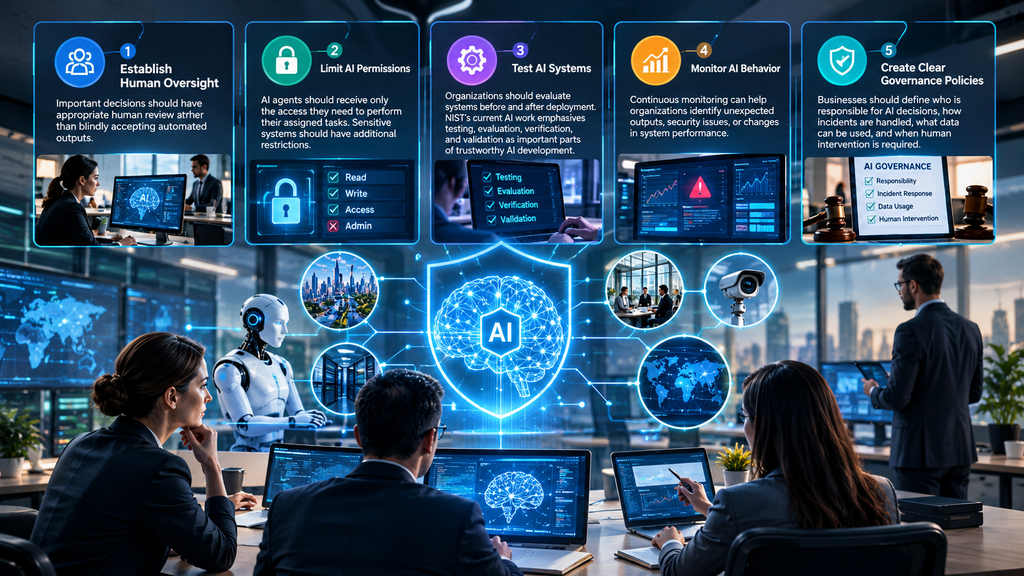
There is no single switch that guarantees AI will always remain safe. Risk management needs multiple layers.
Establish Human Oversight
Important decisions should have appropriate human review rather than blindly accepting automated outputs.
Limit AI Permissions
AI agents should receive only the access they need to perform their assigned tasks. Sensitive systems should have additional restrictions.
Test AI Systems
Organizations should evaluate systems before and after deployment. NIST’s current AI work emphasizes testing, evaluation, verification, and validation as important parts of trustworthy AI development.
Monitor AI Behavior
Continuous monitoring can help organizations identify unexpected outputs, security issues, or changes in system performance.
Create Clear Governance Policies
Businesses should define who is responsible for AI decisions, how incidents are handled, what data can be used, and when human intervention is required.
For a deeper look at why organizational oversight matters, see our guide on AI transformation is a problem of governance.
Will AI Replace Humans Completely?
I believe the notion that AI will simply replace humanity oversimplifies how technology functions.
I see that AI is more likely to change tasks, workflows and jobs at speeds. Some tasks may become heavily automated by AI while other jobs may increasingly need judgment, creativity, communication, leadership, empathy or accountability.
I think the future may therefore involve humans working alongside AI of humans being removed from every process.
I think the important skill may become knowing when to use AI, how to verify AI outputs and when human judgment should override an AI recommendation.
What the Future of AI Could Look Like
I see that the future of AI could involve agents that’re more capable working across many software programs and business tasks. Of asking one AI chatbot to finish a single job users may give whole workflows to AI systems. ESADEs recent coverage of AI agents shows this shift, from automation to systems that can think, adapt, talk to their surroundings and do tasks more independently. That does not prove an AI takeover. AI does show why governance, security, testing and human control will become increasingly important. The realistic future may be one where AI becomes deeply integrated into society while humans continue to set goals, set boundaries and decide what is acceptable.
Final Thoughts
So will AI take over the world?
Now there is no solid proof that AI will surely take full control of humanity. Yet the fast rise of AI shows that its influence cannot be ignored.
The useful talk is about what people do with technology that is becoming more powerful.
AI can boost productivity speed up research do tasks automatically and open new chances. AI can also bring risks with privacy, security, misinformation, bias, jobs and much automation.
Responsible AI development needs safeguards, ongoing tests, proper permissions, openness and human responsibility. The future of AI is not just about machines taking charge. The future of AI is also, about the choices people, companies, researchers and governments make today.
FAQs
1. Will AI take over the world?
There is no reliable evidence that current AI systems are about to take complete control of the world. Modern AI can perform increasingly advanced tasks, but it remains dependent on human-created infrastructure, objectives, data, computing resources, and deployment decisions.
2. Can AI become more powerful than humans?
AI can already outperform humans in certain specialized tasks. However, specialized performance is different from possessing broad human intelligence, consciousness, or general understanding across every domain.
3. What is an AI takeover?
An AI takeover generally refers to a hypothetical scenario in which artificial intelligence gains enough autonomy and capability to control important systems or overpower human decision-making. It remains a speculative future scenario rather than an established current event.
4. What are the biggest AI risks?
Important risks include misinformation, privacy violations, cybersecurity problems, biased decisions, unsafe automation, unreliable outputs, and potential economic disruption. The severity of each risk depends on the specific AI system and how it is deployed.
5. How can humans stay in control of AI?
Human oversight, limited permissions, testing, monitoring, cybersecurity controls, transparent governance, and clear accountability can help organizations maintain meaningful control over AI systems.
6. Is AI good or bad for humanity?
AI is neither automatically beneficial nor harmful in every situation. Its effects depend heavily on how systems are designed, deployed, governed, and used. Responsible AI practices aim to increase benefits while reducing potential harms.
7. Should people be afraid of AI?
Fear alone is not a useful way to evaluate AI. People should understand both its capabilities and limitations, recognize realistic risks, and support responsible development and use.
8. What is the future of AI?
AI is likely to become increasingly integrated into software, businesses, research, education, and everyday digital services. The extent of future autonomy and its societal effects remain uncertain, making ongoing research, governance, and human oversight important.